By: Nana Appiah
Acquaye
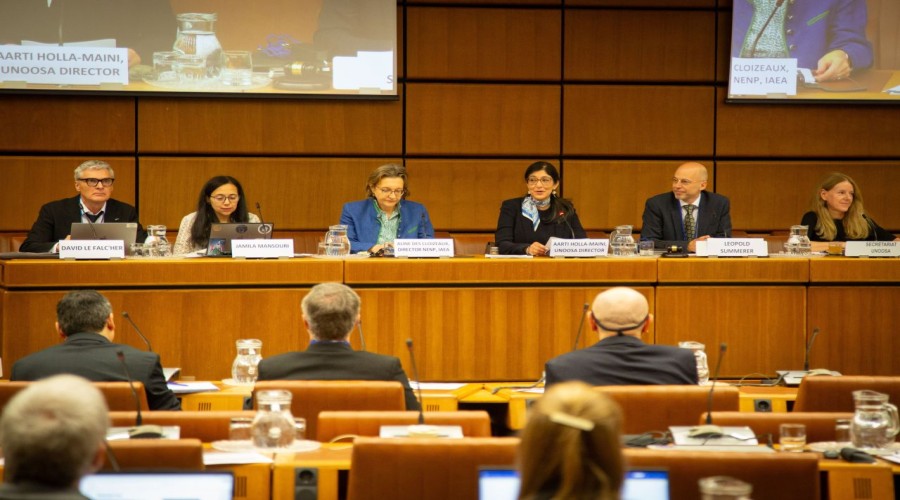
Experts from governments,
international organisations, industry, and academia have gathered in Vienna for
a workshop on the future of nuclear power source applications in outer space,
jointly organised by the United Nations Office for Outer Space Affairs (UNOOSA)
and the International Atomic Energy Agency (IAEA).
The meeting focused on
exchanging knowledge, reviewing emerging technologies, and strengthening
international cooperation as global space exploration enters a new phase of
deep-space missions and renewed lunar ambitions.
According to participants,
nuclear power sources remain a critical enabling technology for space
exploration, particularly for missions beyond Earth’s orbit where solar energy
is limited. These systems have historically supported long-duration missions and
exploration of distant planetary bodies.
The workshop highlighted
ongoing developments in radioisotope power systems and advanced nuclear
reactors, which are expected to play a key role in supporting future lunar
exploration, sustained human presence on the Moon, and potential missions to
Mars and beyond.
Discussions also emphasized
the importance of established international governance frameworks, including
the 1992 Principles on the Use of Nuclear Power Sources in Outer Space and the
2009 Safety Framework developed through cooperation between COPUOS and the
IAEA, to ensure that safety and responsibility remain central to technological
advancement.
The Committee on the
Peaceful Uses of Outer Space (COPUOS) Working Group on the Use of Nuclear Power
Sources in Outer Space continues to support member states in implementing
safety standards, sharing operational experience, and assessing the implications
of future nuclear-powered space systems.
Participants underscored
that international collaboration will be essential in ensuring that the
expansion of nuclear technologies in space remains aligned with principles of
safety, sustainability, and peaceful exploration.
The workshop concluded with
a shared commitment to advancing safe and cooperative approaches to powering
the next generation of space exploration missions.