By: Nana
Appiah Acquaye
Mozambique is fortifying
its cybersecurity framework as the country advances its digital transformation
agenda, with the National Institute of Information and Communication
Technologies (INTIC) highlighting the growing scale of cyber threats and the
need for stronger legal, institutional and technical responses.
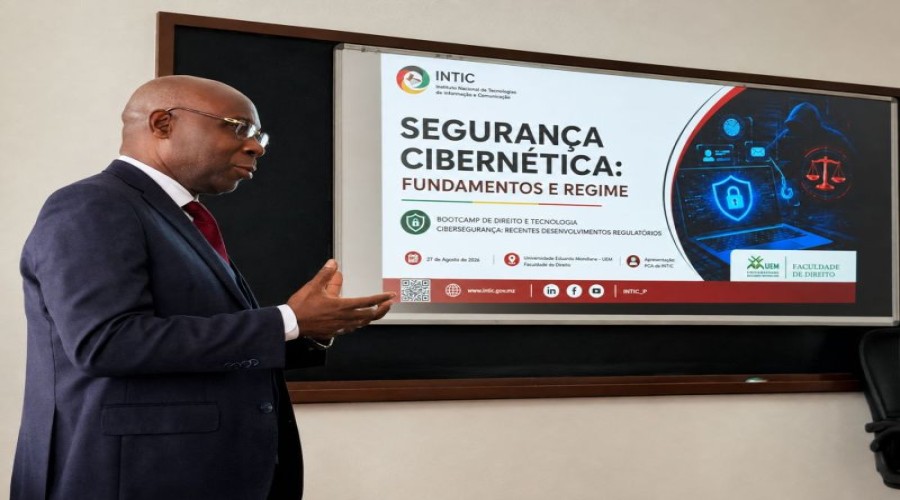
INTIC Chairman of the Board
of Directors, Prof. Dr Eng. Lourino Chemane, made the remarks at Eduardo
Mondlane University (UEM), where he delivered a lecture titled “Cybersecurity:
Fundamentals and Regime” as part of the Law and Technology Bootcamp focused on
recent regulatory developments in cybersecurity.
Chemane outlined the
evolution of Mozambique’s cybersecurity legal framework, with particular
attention to the approval in 2026 of Law No. 13/2026 of July 1, the Cyber
Security Law, and Law No. 14/2026 of July 1, the Cybercrime Law.
He explained that the Cyber
Security Law establishes measures for the prevention, protection and response
to cybersecurity incidents. At the same time, the Cybercrime Law defines offences committed
in cyberspace and provides mechanisms for the collection of electronic evidence
and international cooperation.
“There is no sustainable
digital transformation without digital trust,” Chemane said, stressing that
cybersecurity has evolved beyond a purely technical concern to become a legal,
institutional and national sovereignty issue.
The lecture also presented
data from the National CSIRT (nCSIRT.mz), coordinated by INTIC, showing the
scale of cyber threats detected in Mozambique between January and May 2026.
During the period, more than 12 million spam messages, 887,236 malicious web
pages, 142,979 malicious emails and 4,749 attempted ransomware attacks were
detected.
Chemane further emphasised
the importance of international cooperation in combating cybercrime and
strengthening national cybersecurity capabilities. He referenced Mozambique’s
participation in international instruments including the Malabo Convention, the
Budapest Convention and the United Nations Hanoi Convention against Cybercrime.
The engagement also featured
the presentation of the Proposal for the National Cybersecurity Strategy
2026–2030, which aims to consolidate national cybersecurity capacities and strengthen institutional maturity in the sector.
According to Chemane,
effective implementation of Mozambique’s new cybersecurity laws and policies
will require coordinated action among government institutions, the private
sector, academia and citizens.
He said such cooperation
would be essential to building a safer digital environment and creating the
trust necessary for the continued development of Mozambique’s digital economy.