By: Nana Appiah Acquaye
Science
diplomacy and data-driven development took center stage on the margins of the
Global Data Festival in Nairobi, Kenya, where experts convened to examine the
expanding role of space-based technologies in natural resource governance
across Africa.
During
a session titled “Space for Natural Resource Management,” participants drawn
from government institutions, academia, international organizations, and the
private sector assessed how Earth observation systems, satellite imagery,
remote sensing technologies, and geospatial analytics can be leveraged to
strengthen sustainable management of land and water resources across the
continent. Discussions emphasized the growing importance of data-enabled
policymaking to address challenges such as deforestation, land degradation, and
water resource monitoring, while also underscoring the need for improved
governance frameworks and stronger cross-sector collaboration.
On
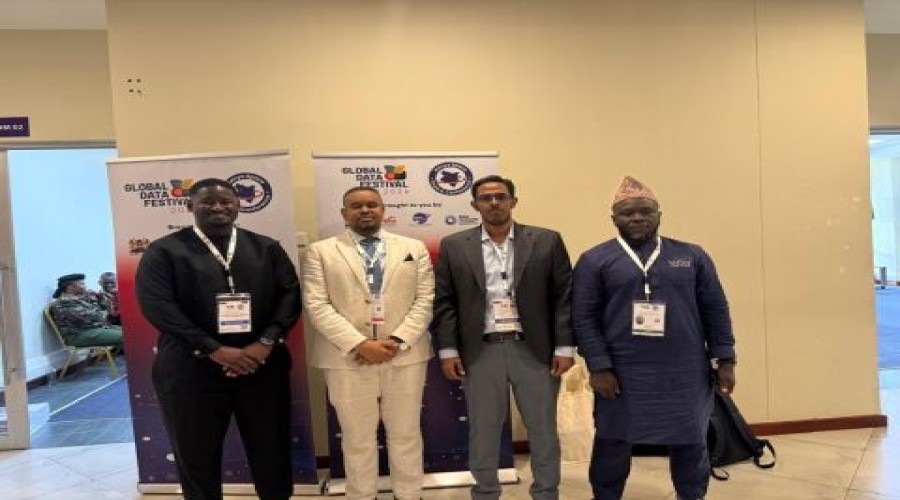
the sidelines of the event, senior officials including M. Ousmane Sylla,
Director of DAPSA, and Dr. Abdisalam Abdirahman Mohamed, Director General of
the Somalia National Bureau of Statistics, held an introductory meeting
facilitated by Dr. Racine Ly, Senegal Country Representative of AKADEMIYA2063.
The meeting provided a platform for exchanging institutional experiences on
data collection and statistical production in challenging and data-constrained
environments, with a particular focus on fragile and conflict-affected
contexts.
The
discussions also explored potential avenues for future collaboration aimed at
strengthening national statistical systems and improving the availability of
reliable development data. In this context, Dr. Ly presented the concept of
DATA SHIELD (Somalian Data Hub with Integrated Earth-observation and Learning
Representation Analytics for Development), an initiative currently under
review. The proposed framework seeks to integrate satellite-derived data with
advanced analytics to address persistent data gaps and support evidence-based
planning in Somalia and similar contexts.
The
initiative is positioned within broader continental efforts led by
organizations such as Africa Agriculture Watch, which focus on harnessing
geospatial intelligence and digital innovation to improve agricultural
monitoring, strengthen resilience, and enhance decision-making systems across
Africa’s development landscape.