Ethiopia launches National Agroecology Strategy to transform food systems
Date: 2026-03-16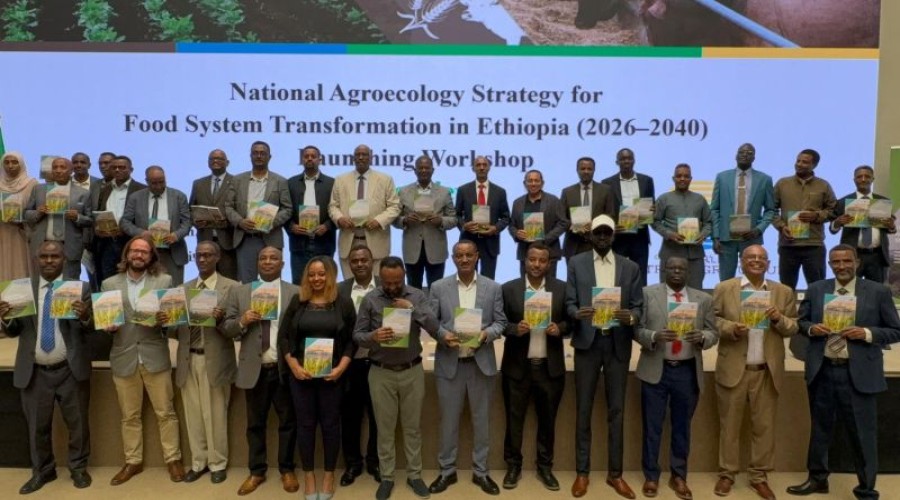
By: Kanto Kai Okanta
Ethiopia
has officially launched its National Agroecology Strategy for Food Systems
Transformation covering the period 2026–2040, aimed at building more resilient,
inclusive, and sustainable agricultural systems across the country.
The
strategy, led by the Ministry of Agriculture of Ethiopia, was developed through
a multi-stakeholder process involving government institutions, research
organizations, development partners, civil society, and private sector actors.
It provides a science-based framework for transforming agricultural landscapes
while improving productivity, restoring ecosystems, and strengthening
resilience to climate change.

Agriculture
remains a central pillar of Ethiopia’s economy and supports the livelihoods of
millions of citizens. However, the sector faces increasing challenges including
land degradation, declining soil fertility, deforestation, and climate
variability. The new strategy promotes agroecology as a pathway to address
these pressures by integrating trees, crops, soils, water resources, and
biodiversity into productive farming systems.
Speaking at the launch, Eyasu Elias, State Minister for Natural Resource Development at the Ministry of Agriculture, said the country must adopt approaches that simultaneously improve productivity while restoring ecosystems and strengthening resilience for farmers and rural communities.

The
initiative also aligns with Ethiopia’s broader national development priorities,
including the Homegrown Economic Reform Agenda and the Green Legacy Initiative,
which promotes large-scale landscape restoration through tree planting.
The
strategy is supported by international partners including the Alliance of
Bioversity International and CIAT and CIFOR-ICRAF under the European
Union-funded TRANSITIONS Programme, managed by the International Fund for
Agricultural Development, which aims to support science-driven approaches to
sustainable agrifood system transformation.