By: Robert
Kwaku Annor
Egypt’s Minister of
Communications and Information Technology, Eng. Raafat Hindi, has inaugurated
the eighth edition of the FDC Summit, where he and Minister of Industry Eng.
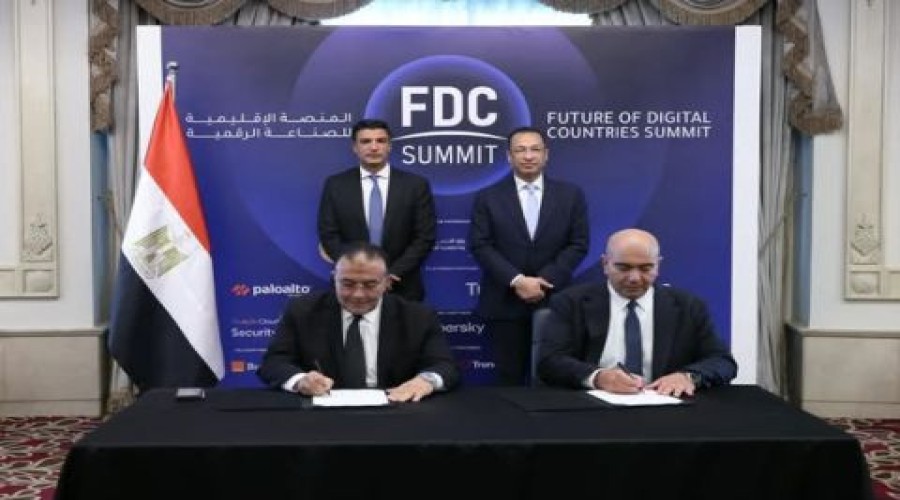
Khaled Hashem witnessed the signing of a memorandum of understanding aimed at strengthening
cybersecurity cooperation in the industrial sector.
The memorandum was signed
between MCS and the Industrial Modernization Center (IMC) on the sidelines of
the summit, which is being held from September 22 to 24 under the auspices of
the Ministry of Communications and Information Technology, the Ministry of
Industry, and the Information and Decision Support Center of the Cabinet.
The agreement focuses on
raising awareness and building capacity in cybersecurity, supporting digital
transformation and cybersecurity readiness within the industrial sector, and
exploring joint initiatives using artificial intelligence, digital transformation
and cybersecurity technologies.
It also provides for
specialised workshops, seminars, forums and events, as well as the exchange of
expertise and best practices locally and internationally.
Speaking at the opening,
Eng. Raafat Hindi said the Ministry of Communications and Information
Technology’s work is guided by a comprehensive vision to build a digital
economy that drives development, contributes to gross domestic product and
creates employment opportunities.
He said the ministry is also
working to improve the delivery of government services, enhance the efficiency
of the state’s administrative apparatus, support innovation and
entrepreneurship, localise technology and develop a knowledge-based economy,
while strengthening digital sovereignty to protect data and support independent
decision-making.
Hindi said Egypt is working
to activate the enablers of digital transformation and provide citizens with an
integrated digital experience for accessing government services remotely. These
efforts include digital identity, electronic signatures and registered digital
email, with the ministry targeting the provision of 400 government services on
the Digital Egypt platform by 2030.
The minister also
highlighted support for entrepreneurship and startups through 24 Digital Egypt
Innovation Centers across 20 governorates. The centres provide skills
development, project incubation and support for connecting companies with
investors and market opportunities.
On artificial intelligence,
Hindi said Egypt began building an integrated national AI framework in 2019.
The second phase of the National Strategy for Artificial Intelligence aims by
2030 to support more than 250 AI startups, train more than 30,000 specialists
and enable 36% of citizens to use AI-supported tools.
He pointed to practical
applications developed for national priorities, including “Karnak,” described
as the first large national Arabic language model developed by Egyptian
engineers at the Applied Innovation Center, alongside applications including
“Lughat” and “Bil Masry.”
Hindi also identified data
centres as critical infrastructure for the digital economy, supporting data
hosting, digital services, artificial intelligence and advanced computing,
while ensuring continuity of vital services and strengthening digital sovereignty.
He said Egypt’s geographical
location and existing digital infrastructure provide an advantage in the
data-centre sector, with 20 international submarine cables passing through the
country and carrying 90% of internet traffic between Europe and Asia. Egypt
aims to convert this position from a data transit advantage into greater
economic value through data hosting and processing, attracting data centres and
cloud services, developing applications and exporting digital services.
The minister said the
ministry is preparing a national strategy for data centres, which it seeks to
launch by the end of 2026 as a comprehensive framework for developing the
industry.
On cybersecurity, Hindi
described the sector as a cornerstone of national security and trust in the
digital economy. He said the state is implementing the second edition of the
National Cybersecurity Strategy 2023–2027 through the Supreme Council for Cybersecurity,
while work has begun on a third edition to address rapid technological
developments and emerging risks.
He said efforts are also
focused on strengthening the readiness of vital sectors to prevent, respond to
and recover from cyberattacks, protecting digital services and ensuring
business continuity.
Hindi further said the
communications and information technology sector remains a key priority for
economic growth, investment and job creation. The sector’s growth rate exceeded
19% during the 2025/2026 fiscal year for the first time, supported by growth of
24.3% during the final quarter of the same fiscal year.
He said Egypt welcomes
companies that bring new capabilities to the local market, transfer knowledge,
support research and development, create quality employment opportunities and
help take Egyptian solutions to regional and global markets. He also expressed
interest in deepening cooperation and exchanging expertise with African
countries.
The eighth FDC Summit brings
together government representatives, agencies and institutions, technology
industry leaders and experts, as well as executives from international,
regional and local companies working in technology, communications, cybersecurity,
artificial intelligence, data centres and digital infrastructure.
He said artificial
intelligence is at the centre of the discussions, alongside data centres and
cloud computing as infrastructure for the digital economy, cybersecurity, data
protection, digital identity and trust in the digital environment.
The summit has also
transitioned into an independent, non-profit institutional entity, bringing
together decision-makers, regulators, legislators, technology companies,
investors and experts to translate dialogue into opportunities, partnerships
and practical solutions.
Following the opening,
Ministers Hindi and Hashem toured the exhibition accompanying the summit, where
international and local companies are showcasing technologies and solutions in
digital transformation, cybersecurity and artificial intelligence.