By:
Van Soul Addey
The Ministry of Food and Agriculture
(MoFA) has launched the Ghana Agricultural Fund for Education and
Transformation (GAFET), a national endowment designed to provide sustainable
financing for agricultural education and the human capital needed to transform
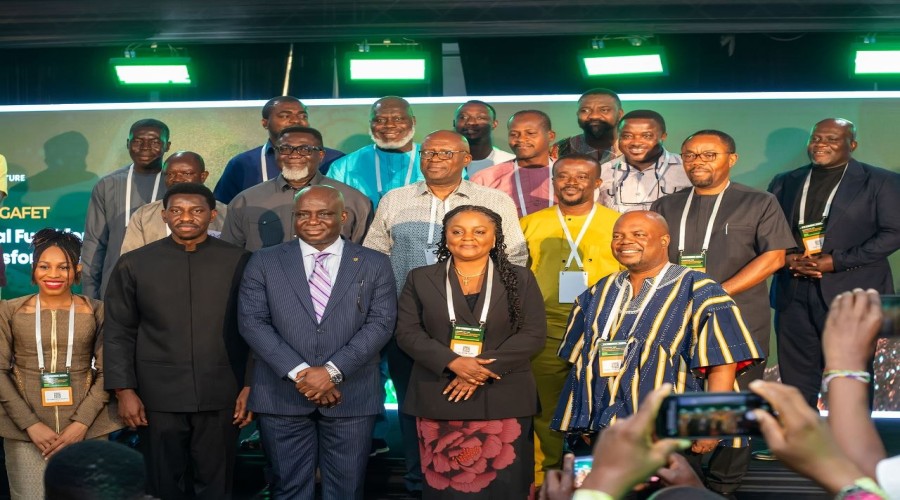
the sector. The Fund was formally launched by the Minister for Food and
Agriculture, Honourable Eric Opoku, at a ceremony in Accra attended by
development partners, financial institutions, agribusiness leaders, traditional
authorities, students and the media.
GAFET seeks to address a critical
imbalance in Ghana’s economy. Agriculture contributes more than a fifth of the
economy, yet only about 2 percent of tertiary students are enrolled in
agricultural programmes, while agricultural education institutions face an
estimated annual funding gap of GH¢12 million.
The Fund will pool contributions
into a professionally managed endowment, with the capital preserved and
invested and annual returns used to finance approved priorities across the
agricultural education system. “If Ghana wants to transform agriculture, it
must invest in the people who will transform agriculture,” Steven Nhyira
Odarteifio, Lead Coordinator of GAFET said.
He added that GAFET would focus on
closing the gap between classroom learning and the practical demands of modern
agriculture by supporting laboratories, demonstration farms, mechanisation,
digital agriculture, research and innovation, agribusiness incubation and
faculty development. He said the objective was to ensure that graduates leave
agricultural institutions with the technical and entrepreneurial capabilities
required to participate meaningfully in a modern, technology-driven
agricultural economy.
He also called for broader
participation from the private sector, financial institutions, development
partners, alumni associations and individuals, arguing that the fund’s
long-term success would depend on its ability to build a broad national
ownership base. “This fund does not end today. Today is only its birth. Let
history recall that when the call came to rebuild Ghana’s agricultural future,
government provided the vision, the private sector provided the confidence, and
development partners provided their partnership, and together we built an
institution that future generations will thank us for,” he said.
Delivering the keynote address, Hon.
Opoku described GAFET as a human-capital pillar of the government's flagship
Feed Ghana programme. “Before we can sustainably feed Ghana, we must equip
Ghana. The quality of agricultural transformation will depend on the quality of
agricultural human capital,” he said.
The Minister, who was flanked by
high ranking personnel of the ministry, including his deputy, Hon. John Setor
Dumelo, called on commercial banks, pension funds, insurance companies,
agribusinesses, development partners, philanthropic foundations and alumni
associations to support the Fund through contributions to laboratories,
workshops, demonstration farms, scholarships and agricultural colleges. He also
highlighted recent increases in funding to agricultural colleges, from
GH¢35,000 to GH¢100,000 per institution, which he said had contributed to a 35
percent increase in enrolment.
GH¢3.5million raised at launch
GAFET has mobilised GH¢3.5 million
in founding capital and aims to grow the fund to GH¢10 million by December 2026
and GH¢100 million by December 2028. The Fund is expected to transition to a
full endowment structure in the fourth quarter of 2026, with a governing board,
fund administrator, fund manager and custodian bank. It is ultimately expected
to become a permanent statutory institution established by an Act of
Parliament.
Its governance framework will
include a Securities and Exchange Commission-licensed fund manager, independent
annual audits, an approved investment policy focused on capital preservation
and published annual summaries. GAFET will initially support 21 agricultural
education institutions, comprising five standalone agricultural colleges and 16
universities and technical universities. Returns from the endowment will
support practical training, mechanisation, research and innovation, digital
agriculture, agribusiness incubation, faculty development and scholarships.
Secretariat Technical Lead Seyram
Kofori-Ndinya said the Fund’s governance would be critical to maintaining
public confidence. “Our objective is to show how the Fund will be governed, so
that every contribution made today actually outlives all of us in this room,”
she said.