Liability and insurance take center stage at first UN Space Debates
Date: 2026-02-17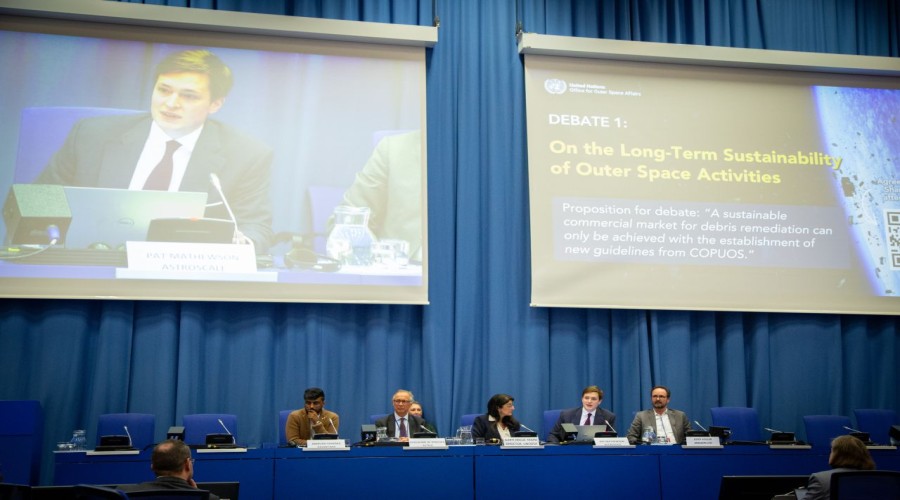
By: Nana Appiah Acquaye
Questions
surrounding liability, insurance, and the sustainability of the orbital economy
dominated discussions at the inaugural UN Space Debates held during the 63rd
session of the Scientific and Technical Subcommittee.
Participants
delivered a clear message on the financial realities of operating in space,
encapsulated in the warning that without insurance, space activities cannot
proceed. The debate underscored growing concerns about how the global space
ecosystem would respond if responsibility for damage caused by space debris
could be definitively established.

The
conversation drew attention to the economic implications of uncertainty in
orbital incidents. Industry experts referenced recent satellite losses,
including Inmarsat-6 F2 and Paz SAT NG, which resulted in claims valued at
hundreds of millions of dollars. In both cases, investigators were unable to
conclusively determine whether the damage was caused by human-made debris or
natural particles.
Speakers
noted that this persistent ambiguity has, for now, prevented major disruptions
in the insurance market. However, they cautioned that a future incident clearly
linked to space debris could trigger significant shifts. Potential consequences
discussed included rising insurance premiums, stricter exclusions, and reduced
insurability of certain orbital regimes.
Debris
mitigation and removal also featured prominently in the discussions. Technical
experts emphasized that active debris removal remains a complex engineering
challenge. Safely approaching and capturing large defunct objects in orbit was
described as feasible but not yet routine.
The
need for improved situational awareness emerged as another critical theme.
Panelists stressed that before large-scale debris removal can become viable,
the international community must develop a shared and reliable understanding of
the objects currently in orbit. Accurate tracking and data transparency were
identified as foundational requirements.

From a commercial perspective, industry representatives argued that economic viability will depend on operational efficiency and international cooperation. The ability for a single debris removal mission to service objects associated with multiple countries was highlighted as a key factor in reducing costs and scaling activities.
Across
differing viewpoints, participants converged on several guiding principles
necessary for the evolution of space governance. These included enhanced
transparency, robust information sharing, clear consent and authorization
frameworks, and strong safety and oversight mechanisms.
The
debates reflected a broader recognition within the space community that
governance frameworks are not peripheral considerations but central enablers of
market stability and long-term sustainability. The discussions signaled a shift
from questioning the necessity of regulation to focusing on how and when
effective governance structures should be established.