Regional workshop on microsatellite technologies opens in Abidjan
Date: 2026-01-30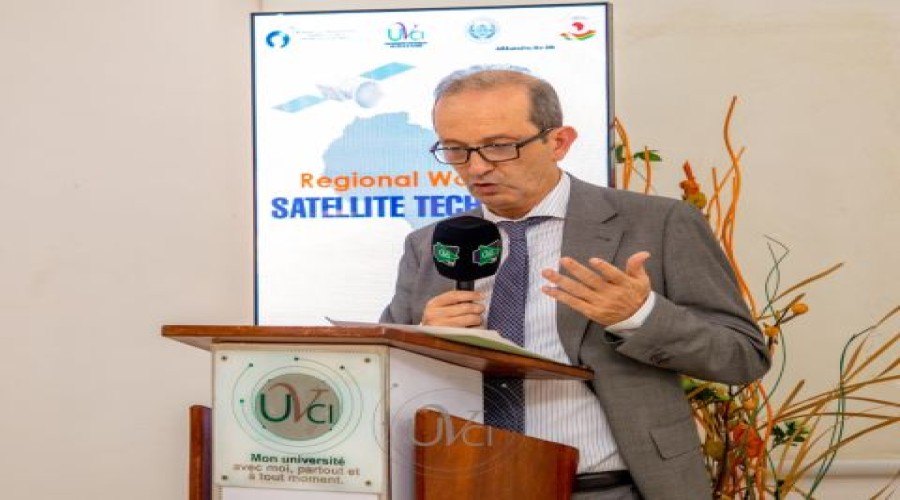
By: Nana Appiah Acquaye
A
regional workshop on satellite technologies opened in Abidjan, focusing on
capacity building in microsatellite development, particularly CubeSat-type
nano-satellites. The workshop is being held under the capacity-building
programme of the African Regional Centre for Space Science and Technology in
French Language (CRASTE-LF).
Hosted
at the headquarters of the Virtual University of Côte d’Ivoire (UVCI), the
activity is jointly organised by UVCI in close collaboration with CRASTE-LF and
the Regional Centre for Space Science and Technology Education for Asia and the
Pacific (RCSSTEAP-China), both affiliated with the United Nations. The
programme also benefits from the academic support of Beihang University, with
additional backing from the Mohammadia School of Engineering of Mohammed V
University in Rabat and the Moroccan Agency for International Cooperation.

The
opening ceremony was chaired by Professor Arsène Kobéa, Chief of Staff of the
Minister of Higher Education and Scientific Research of Côte d’Ivoire. In his
address, he highlighted the strategic importance of microsatellites as
accessible, flexible and cost-effective solutions for developing countries. He
also recalled Côte d’Ivoire’s recent advances in the space sector, notably the
establishment of the Ivorian Space Agency on June 4, 2025, and emphasized the
relevance of microsatellite technologies for Earth observation, scientific
research and innovation across Africa.
The
workshop, supervised by experts from Beihang University, runs until January 30,
2026. It provides advanced training with a strong practical focus, covering
areas such as satellite structural design, thermal control, navigation systems
and space mission engineering.

Participants
and experts from Cameroon, Côte d’Ivoire, Morocco, Senegal and China are taking
part, with the shared objective of developing skilled human capital capable of
contributing meaningfully to the growth of Africa’s space sector.
Through
this initiative, CRASTE-LF continues to advance its mandate of disseminating
scientific knowledge and strengthening capacity in space science and technology
across the continent.