
Davos 2026: World Economic Forum to establish five new centres for the Fourth Industrial Revolution
Date: 2026-01-25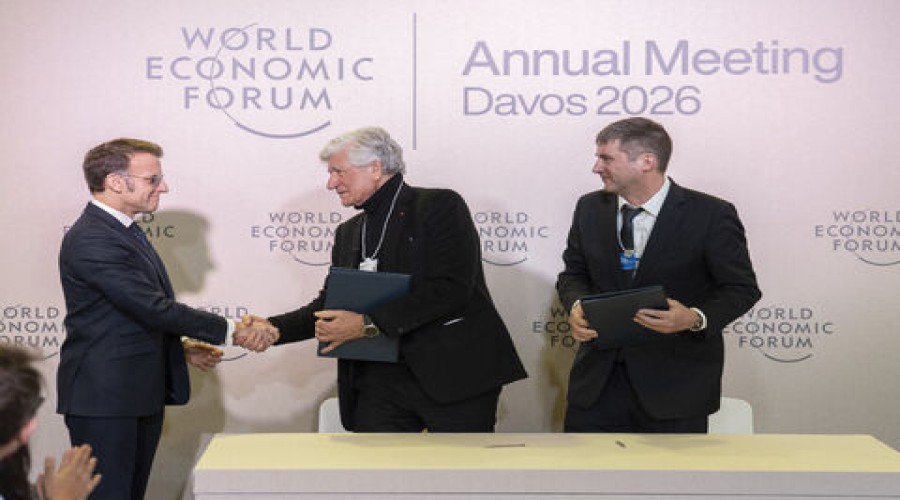
By: Nana Appiah Acquaye
The World Economic Forum has announced the signing of agreements
to establish five new Centres for the Fourth Industrial Revolution (C4IR),
expanding its global network focused on the responsible development and
deployment of emerging technologies.
The
new centres will be located in France, the United Kingdom, the United Arab
Emirates and India, and will concentrate on strategic priorities including
artificial intelligence, frontier technologies, the energy transition and cyber
resilience. Each centre will work closely with governments, industry and other
stakeholders to develop practical policy frameworks, launch pilot projects,
address regional priorities and strengthen international cooperation.
The
expansion is expected to reinforce the Forum’s Fourth Industrial Revolution
Network, which brings together public and private sector actors to translate
technological innovation into adaptable, real-world solutions that support
responsible technology adoption.
Commenting
on the development, World Economic Forum President and Chief Executive Officer
Børge Brende said the launch of the new centres reflects the importance of
multistakeholder collaboration in addressing shared technology challenges. He
noted that local and regional insights provided by partners will strengthen
global efforts to advance emerging technologies responsibly.
In
France, the European Centre for AI Excellence will be launched in Paris in
partnership with VivaTech. As part of the global 4IR Network, the centre will
focus on accelerating responsible AI innovation and adoption to enhance
Europe’s global competitiveness. It will mobilize projects and partnerships to
strengthen the regional AI ecosystem and support the deployment of AI across
multiple sectors. Maurice Lévy, Chairman of the European Centre for AI
Excellence and Co-President of VivaTech, said the centre brings Europe’s
perspective to the forefront of AI, advancing sovereign and trustworthy AI
while strengthening competitiveness across technology and industry.
In
the United Kingdom, the Centre for AI-Driven Innovation will be hosted by
Imperial College London. The centre will focus on the development and adoption
of advanced AI technologies across key UK sectors, while exploring the
convergence of AI with frontier technologies such as quantum computing,
biotechnology and generative AI. Professor Hugh Brady, President of Imperial
College London, said the centre builds on the institution’s track record of
translating research into real-world impact through responsible and scalable AI
adoption.

The
United Arab Emirates will host two new centres in Abu Dhabi. The Centre for
Frontier Technologies, hosted by the Technology Innovation Institute, will
advance innovation in areas including quantum technologies, robotics and space,
while promoting public-private collaboration to support responsible deployment.
Dr. Najwa Aaraj, Chief Executive of the Technology Innovation Institute, said
the centre will combine research excellence, policy leadership and global
collaboration to move frontier research beyond the laboratory into real-world
application.
Also
in Abu Dhabi, the Centre for Intelligent Future will be hosted by Mohamed bin
Zayed University of Artificial Intelligence. The centre will focus on
strengthening global AI capabilities across research, infrastructure, adoption
and innovation, convening leaders from government, business, civil society and
academia. MBZUAI President Eric Xing said the centre will connect frontier AI
research to pressing economic, social and human challenges, reinforcing the
university’s role in shaping technological and societal development.
In
India, the Centre for Energy and Cyber Resilience will be established in
partnership with the Government of Andhra Pradesh. The centre will promote
innovation-led approaches to the energy transition while strengthening cyber
resilience across industries through pilots, consultations and knowledge
exchange. Andhra Pradesh Chief Minister N. Chandrababu Naidu said the
partnership reflects a commitment to building capacity in areas such as energy
security, cyber resilience, trusted digital systems and large-scale talent
development.
Together,
the new centres are expected to further strengthen the Fourth Industrial
Revolution Network by bringing governments, industry and experts together
around shared technology challenges. As the network continues to expand, it
will support the responsible development and deployment of emerging
technologies to address global priorities.
The
Fourth Industrial Revolution Network, launched by the World Economic Forum in
2017, serves as a platform for multistakeholder collaboration aimed at ensuring
emerging technologies deliver broad societal benefits while minimizing risks.
The network includes national and thematic centres across Europe, the Middle
East, Asia and the Americas, supporting responsible innovation across a wide
range of sectors.
The
announcement was made during the World Economic Forum’s 56th Annual Meeting,
held from 19 to 23 January 2026 in Davos-Klosters, Switzerland, under the theme
“A Spirit of Dialogue.”


