
ICT Minister engages defense attachés on Egypt’s digital strategy and ICT sector developments
Date: 2025-12-31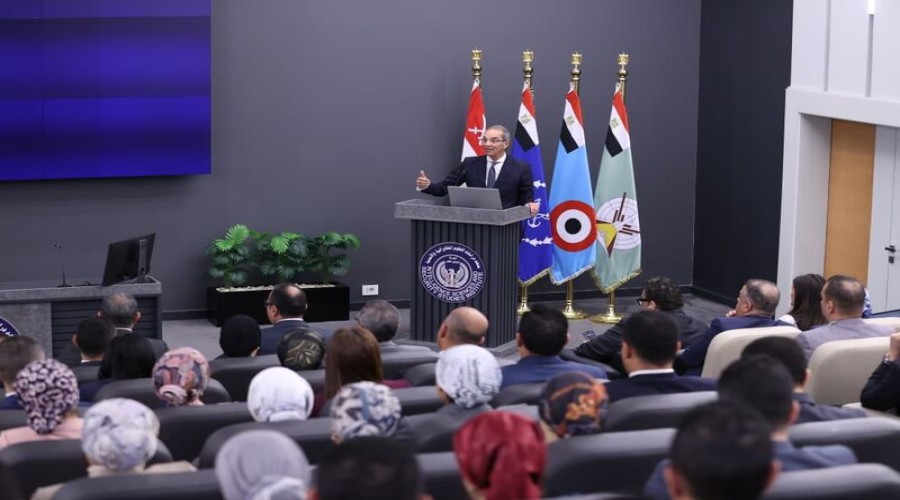
By: Nana Appiah Acquaye
Egypt’s
Minister of Communications and Information Technology, Amr Talaat, has met with
Armed Forces officers nominated to serve as defense attachés at Egyptian
embassies abroad, as part of the Training Program for Egyptian Military
Diplomatic Representation Abroad. The meeting was held at the Intelligence and
Security Sciences Studies Institute in the presence of the Head of the Military
Attachés Agency, Mohamed Salah El-Din Qatat.
During the meeting, Talaat indicated that the ICT sector has become a major arena of global competition amid rapid advancements in artificial intelligence and semiconductor technologies, alongside the increasing scale of cyberattacks that directly impact national security. He stated that the sector has evolved beyond a service-based role to become a productive and strategic pillar for national development.
The
Minister explained that the Digital Egypt strategy, launched in 2018, seeks to
maximize the ICT sector’s contribution to economic growth through job creation
within a knowledge-based economy, expansion of digital exports, digitization of
government services, and the promotion of entrepreneurship and digital
innovation. He added that the strategy is supported by robust digital
infrastructure and a legislative framework aimed at protecting citizens’ data
while enabling innovation.
Talaat
highlighted Egypt’s strategic position in global data traffic, noting that the
country currently hosts 21 international submarine cables, carrying about 90
percent of data traffic between Asia and Europe, with more than 60 countries
benefiting from connectivity through Egypt. He emphasized the state’s
commitment to strengthening its capabilities in international submarine cable
services and delivering competitive digital infrastructure.

Addressing
human capacity development, the Minister outlined Egypt’s approach to
specialized technical education through the establishment of WE Applied
Technology Schools, with 27 schools now operating nationwide to prepare
students for ICT-related careers. He also referred to the Egypt University of
Informatics, Africa’s first specialized ICT university, which has formed
partnerships with leading international institutions. He noted that the
university celebrated its first graduating class this year, recorded a
thirteenfold increase in applicants, and is set to complete its second
expansion phase next year.
Talaat
further reviewed MCIT’s digital capacity-building initiatives, which include
training programs targeting diverse professional groups such as media
practitioners, judges, and journalists to support the adoption of AI
technologies. He stated that the Ministry aims to train 800,000 individuals
during the current year, with the target rising to one million trainees by
2030, supported by the establishment of 24 Creativa Innovation Hubs across
various governorates.
The
Minister also highlighted Egypt’s growing position in the global offshoring
industry, noting that the number of offshoring centers has exceeded 270,
providing digital services to international markets. He said more than 60,000
jobs have been created in the sector over the past three years, with recent
agreements signed with 55 companies expected to generate an additional 75,000
job opportunities.
Talaat
disclosed that digital exports reached USD 7.4 billion in 2025, with a target
of USD 9 billion in the coming period. He added that Egypt has attracted 15
mobile phone manufacturing brands, producing 10 million devices in 2025 with a
local added value of 40 percent, and aims to increase production to 15 million
units next year while commencing exports.
Concluding
his remarks, the ICT Minister noted that the Digital Egypt platform currently
provides 210 services to more than 10 million registered users. He said ongoing
efforts include the expansion of fiber-optic networks nationwide, improvements
in service quality and indoor mobile coverage, and preparations following the
rollout of 5G services, alongside the continued digitization of public services
for citizens and Egyptian expatriates.


