
ICT Minister meets NTRA Telecom Industry Committee to review priorities for Egypt’s telecom sector
Date: 2025-12-29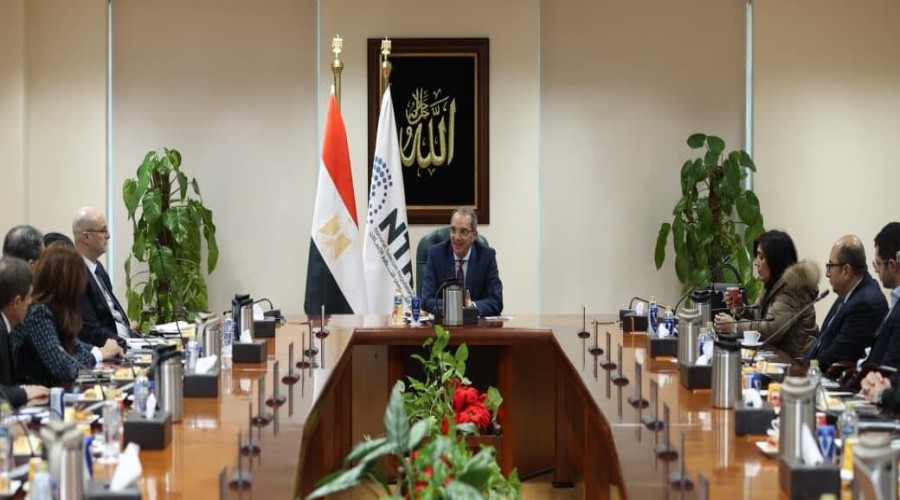
By: Kanto Kai Okanta
The Minister of
Communications and Information Technology, Amr Talaat, has met with members of
the Telecom Industry Committee of the National Telecom Regulatory Authority
(NTRA) following the committee’s new formation, which brings together senior
ICT leaders and industry experts.

The meeting
focused on key strategic pillars for advancing Egypt’s telecommunications
industry, as well as anticipated challenges in the period ahead. Discussions
also reviewed ongoing state efforts, through the NTRA and the Telecom Industry
Committee, to support the ICT sector and strengthen its competitiveness in line
with the Digital Egypt strategy and the broader objective of building a
knowledge-based economy.
In his remarks,
Talaat noted that Egypt’s ICT sector has undergone an unprecedented
transformation, evolving into a productive, service-driven sector that plays a
central role in economic growth and sustainable development. He stated that the
sector has recorded the highest growth rates nationwide for the seventh
consecutive year, ranging between 14 and 16 percent, and now contributes around
6 percent to the country’s gross domestic product.
The minister
referenced outcomes from the Global Offshoring Summit 2025, which saw the
signing of agreements with 55 international and local companies to expand their
operations in Egypt, creating approximately 75,000 new job opportunities. He
highlighted the government’s strong commitment to supporting the offshoring
industry, underscored by a recent meeting between the President of the Republic
and executives of participating companies.

Talaat further
disclosed that digital exports have increased by 124 percent over the past
seven years to reach USD 7.4 billion, while offshoring exports doubled over
three years to USD 4.8 billion in 2025. He also pointed to Egypt’s progress in
the World Bank’s 2025 GovTech Maturity Index, where the country advanced 47
positions to rank 22nd globally, reinforcing its placement among leading
countries in Group A.
The minister
also highlighted ongoing national efforts in cybersecurity, including Egypt’s
signing of the United Nations Convention against Cybercrime and cooperation
plans to establish the Egyptian-African Center for the Prevention and Combat of
Cybercrime in partnership with the United Nations Office on Drugs and Crime.
On local
manufacturing, Talaat said Egypt has attracted 15 major global mobile phone
manufacturers, achieving a local component exceeding 40 percent. He noted that
more than 10 million mobile devices were produced this year, compared to 3.3
million in the previous year, adding that the mobile device governance system
is primarily intended to protect and support domestic manufacturing.

He also
outlined the role of the NTRA and the Telecom Industry Committee in introducing
new services, including 5G networks, Internet of Things services for vehicles,
Wi-Fi Calling to enhance indoor call quality, and the eSIM service, which
offers users greater flexibility in managing mobile lines.
At the
conclusion of the meeting, the Telecom Industry Committee issued a set of
recommendations aimed at supporting the national telecom industry. These
included calls to open new avenues for sector development, address challenges
related to local manufacturing, explore opportunities in data centers and cloud
computing, expand domestic production of telecom equipment, and establish
effective mechanisms to support local manufacturers.
Closing the
engagement, Talaat expressed confidence in the committee’s role in its new
formation, describing it as a key platform for strengthening coordination among
stakeholders and reflecting the state’s commitment to unified action and deeper
collaboration to advance Egypt’s telecommunications industry.


