
African space economy valued at USD 24.95 billion, set to reach USD 39.52 billion by 2030
Date: 2025-12-21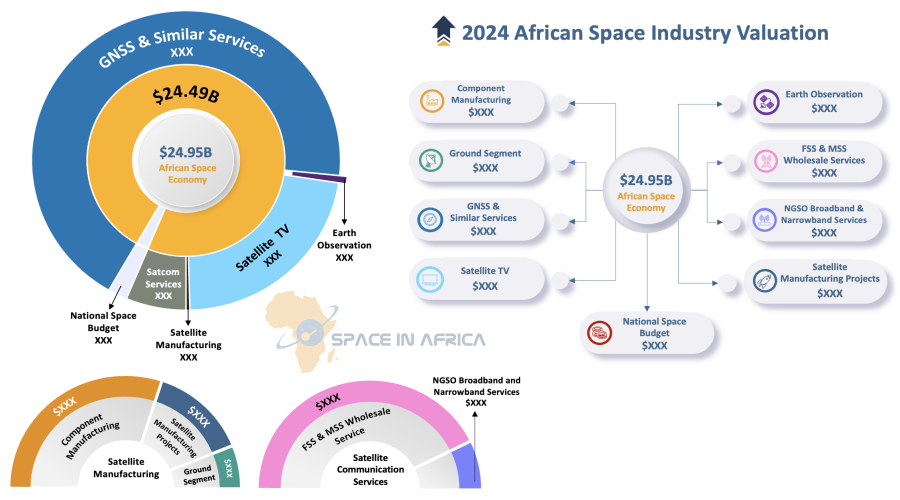
By: Nana Appiah Acquaye
Africa’s
space economy was valued at USD 24.95 billion in 2024 and is projected to grow
to USD 39.52 billion by 2030, according to the African Space Industry Annual
Report 2025 Edition released by Space in Africa.
The
report, published by the boutique consulting and media firm known for its
data-driven analysis of the continent’s space sector, estimates the industry
will expand at a compound annual growth rate of 7.97 percent over the period.
Space in Africa describes the publication as the definitive reference for
understanding Africa’s space ecosystem and a trusted resource for global
stakeholders involved in strategic planning.
The
new valuation exceeds earlier projections published in the firm’s 2022 report,
which estimated the African space industry at USD 19.49 billion in 2021 and
forecast growth to USD 22.64 billion by 2026. According to the latest data, the
industry has already surpassed that forecast by USD 2.31 billion, reaching the
milestone two years ahead of schedule.

Space
in Africa attributes the accelerated growth to sustained momentum across the
public, private, and intergovernmental actors that make up the African space
value chain. The report notes that the continent’s space activities are
increasingly interconnected, with countries and institutions operating through
partnerships rather than in isolation.
The
valuation is based on a comprehensive bottom-up assessment of nine core
segments of the African space industry, reflecting the full breadth of
activities across the ecosystem. Beyond market size estimates, the report
provides extensive analysis of satellite manufacturing trends, including
procurement pipelines in 13 African countries, contractor partnerships, and
cost breakdowns covering manufacturing and launch by mission type, orbit, and
satellite size.
It
also offers comparative benchmarking of national space programmes, analysing
space budgets in relation to gross domestic product, defence spending, and per
capita investment. The report maps more than 300 African space companies,
categorising them by market reach and industry segment to highlight emerging
opportunities for investors and entrepreneurs.
In
addition, the publication examines national space policies across eight key
African countries, assessing priorities and effectiveness while offering
recommendations for strengthening governance frameworks. Geopolitical dynamics
are also explored, including Africa’s engagement with global initiatives such
as the Artemis Accords and the International Lunar Research Station, alongside
an assessment of international partnership models.

The
report further covers infrastructure and applications, with analysis of ground
station distribution, Earth observation market trends, and the use of
space-based services in sectors such as agriculture, disaster management, and
natural resource monitoring. It also reviews major astronomy initiatives,
including the Square Kilometre Array project, and provides an overview of
active space projects and their funding landscape across the continent.
Space
in Africa said the 2025 edition is intended to serve a wide range of
stakeholders, including satellite manufacturers, investors, policymakers,
telecommunications operators, development agencies, and academic institutions.
The report analyses 65 satellites launched by African countries between 1998
and 2025 and outlines transparent valuation methodologies alongside actionable
market insights.
The
African Space Industry Annual Report 2025 Edition is available for purchase
from Space in Africa.
Leave Your Comments
Trending News