By: Nana Appiah Acquaye
The
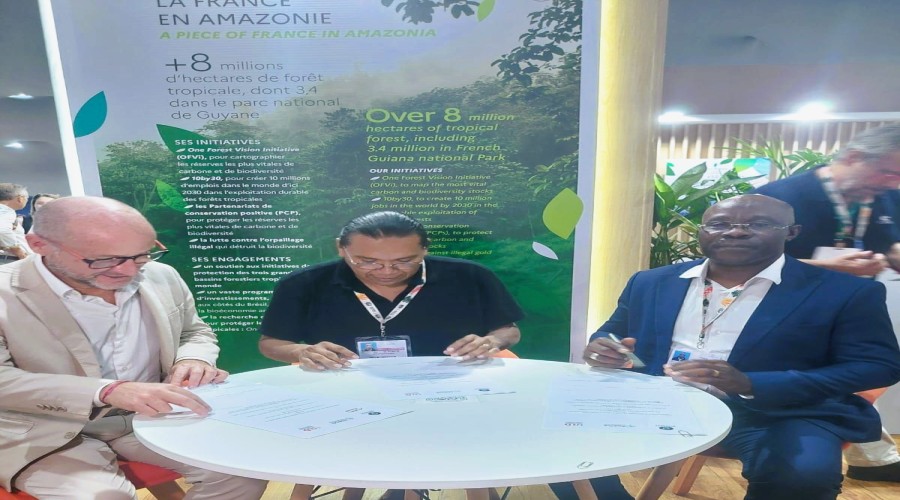
Gabonese Agency for Space Studies and Observations (AGEOS) and the Territorial
Collectivity of French Guiana have signed a Memorandum of Understanding (MoU)
aimed at deepening scientific and technological collaboration between the Congo
Basin and the Amazon Basin. The agreement, concluded on the sidelines of COP30,
is supported by the Institute of Research for Development (IRD) and marks a
significant step in South-South cooperation focused on safeguarding tropical
forests.
The
MoU was signed by Aboubakar Mambimba Ndjoungui, Director General of AGEOS, Jean
Paul Fereira, First Vice-President of the Territorial Collectivity of French
Guiana, and Gilles Pécassou, Director General of IRD. The partners committed to
enhancing shared satellite observation capabilities, promoting sustainable
forest management, and strengthening evidence-based public policy development.
According
to the parties, the collaboration is anchored on three main pillars. The first
is Earth observation, which will involve linking the capacities of the SEAS
Gabon and SEAS Guyana ground stations to improve access to rapid, high-quality
satellite data for monitoring forest ecosystems. The second pillar focuses on
sustainable management of tropical forests through the integration of space
science and fundamental research to support decision-making on issues such as
deforestation, biodiversity preservation and climate-related challenges. The
third pillar centers on transforming spatial and scientific data into
actionable insights for governments to support land-use planning and long-term
forest governance.
Officials
said the agreement reflects a shared commitment by Gabon and French Guiana to
present a united front in advocating for the protection of tropical ecosystems
essential to global climate stability. As part of the broader COP30 agenda, the
partnership seeks to reinforce scientific cooperation across the Global South
and promote environmental solidarity between two of the world’s most important
forest regions.
By
linking the Amazon and the Congo Basin, the initiative aims to leverage
satellite technology and research expertise to advance sustainable development,
strengthen environmental sovereignty and contribute to global climate
resilience.