OmniBSIC Bank Ghana LTD has taken a bold step
toward redefining financial inclusion in Ghana with the introduction of its
Braille-Assisted Services for visually impaired customers. This initiative,
unveiled as part of the Bank’s Limitless Banking strategy, demonstrates
OmniBSIC’s vision to make banking accessible, connected, and empowering for
all, irrespective of physical ability or background.
The Braille-Assisted Services are designed to
enable visually impaired customers to conduct transactions independently,
securely, and with dignity. By providing Braille versions of key banking
documents, OmniBSIC is removing one of the most persistent barriers to
financial participation for the visually impaired community: limited access to
clear, accessible information.
According to the Ghana Statistical Service,
about 4 percent of Ghanaians, over 1.2 million people, live with some form of
visual impairment. Many rely on friends or relatives for assistance in reading
documents or navigating banking halls, a dependency that often undermines
privacy and confidence. OmniBSIC’s new service changes that narrative, allowing
customers to open accounts, read information, and make decisions autonomously.
Daniel Asiedu, Managing Director and Chief
Executive Officer of OmniBSIC Bank, described the initiative as a powerful
reflection of the Bank’s ethos. “At OmniBSIC, we believe banking should be
for everyone, everywhere. Our Braille-Assisted Services are not just a
technological addition; they are a statement of our belief that accessibility
is a right, not a privilege,” he said. “We want every customer to
experience the same dignity, independence, and confidence when they visit our
banking halls or use any of our digital platforms” he added.
Furthermore, he added that the bank seeks to
extend banking services to all persons with disabilities not just the visually
impaired.
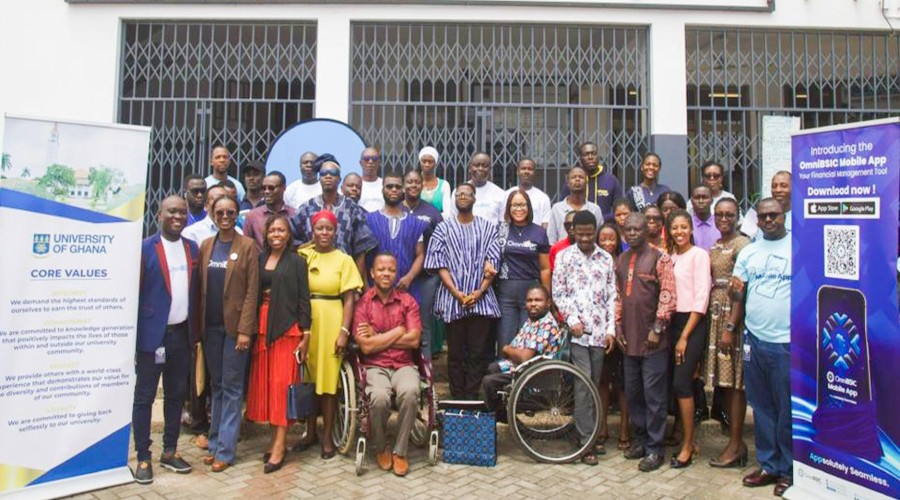
With this in mind, the Bank, during the 2025
Global Customer Service Week under the theme ‘Mission: Possible’ engaged
students of the University of Ghana at the Assistive Technology Lab under the auspices
of University of Ghana’s Institutional Advancement Directorate, Information
Technology Directorate, as well as the Centre for Disability Studies and Advocacy
(CEDSA).
The engagement marked a significant moment in
OmniBSIC’s financial inclusion and accessibility journey, as the Bank seeks to
deepen collaboration with academia and advocates in shaping inclusive financial
solutions.
At the event, Mrs. Chidinma Braye-Yankee, Group
Head of Corporate and Support Services reaffirmed OmniBSIC’s stance that
inclusion is a mission requiring empathy, innovation, and strategic partnerships.
“We do not presume to know what our customers need. We want to listen,
learn, and co-create solutions that make every interaction meaningful,” she
explained.
“Our goal is to ensure that everyone,
regardless of income level, gender, location, ability, or background, has fair
and convenient access to financial services that empower them to thrive.
Inclusive banking is not just an option, it is essential,” she added. “As
a bank, we are not just investing in technology, we are investing in people.
Through initiatives like this, we are building a system where no one is left
behind, and every customer can transact independently and with confidence,” Mrs.
Braye-Yankee noted.
The team took a tour of the University of
Ghana’s Assistive Technology Lab, where they saw assistive equipment such as
voice-assisted computers and screen-reading devices and how they were being
used. They were also able to interact with students regarding their experiences
and feedback.
OmniBSIC Bank Executive Management officials present
at the event, reiterated that such innovations align with the Bank’s digital
transformation agenda, which integrates accessibility across platforms.
Engineer Francis Kwabena Boakye, Chief
Information Technology Officer-(CITO) of the University’s Information
Technology Directorate, praised the visit as the first of its kind by a
financial institution. “This collaboration connects the ideals of academic
innovation with real-world impact. Through this shared effort, we can ensure
that technology truly empowers all,” he said.
A key point of the event was a presentation by
Mr. Alexander Bankole Williams, Head of Assistive ICT Lab, who spoke on ‘The
Future of Banking: Enhancing Access for Persons with Disabilities in
Ghana’.
Drawing on his 25 years of advocacy and
personal experience as a visually impaired professional, Mr. Williams stated that financial inclusion for
persons with disabilities is not a matter of charity but a right. Citing the
Persons with Disability Act, 2006 (Act 715), he stressed that all public goods
and services must be made accessible to everyone. “Accessibility is not
optional, it is a legal and moral imperative,” he said, urging other
institutions to emulate OmniBSIC’s example.
Professor Joana Salifu Yendork, Director of the
Centre for Disability Studies and Advocacy (CEDSA), encouraged customer-facing
institutions to adopt a “total inclusivity approach,” one that ensures
equal access and respect for all persons, regardless of the perceived severity
of their disabilities.
During the Q & A session, the Bank
announced that it had commenced the braille assistive services, as well as staff
training on visual impairment awareness and will extend sensitisation
programmes across its 40-branch network to strengthen service delivery for
customers with special needs.
OmniBSIC Bank
is committed to collaborate with strategic partners to promote inclusive
financial services and assistive technology innovation, in line with
Sustainable Development Goal 10, which calls for the social, economic and
political inclusion of all people, including persons with disabilities as well
as Bank of Ghana’s Financial Inclusion for Persons with Disability Directive.
By: Nana Appiah Acquaye