By: Nana
Appiah Acquaye
CERN Advisor for Relations
with Ghana Martin Gastal has presented the European Organization for Nuclear
Research’s Quantum Technology Initiative (QTI) to researchers and students at
the Kwame Nkrumah University of Science and Technology (KNUST), highlighting
opportunities for collaboration and engagement in quantum science.
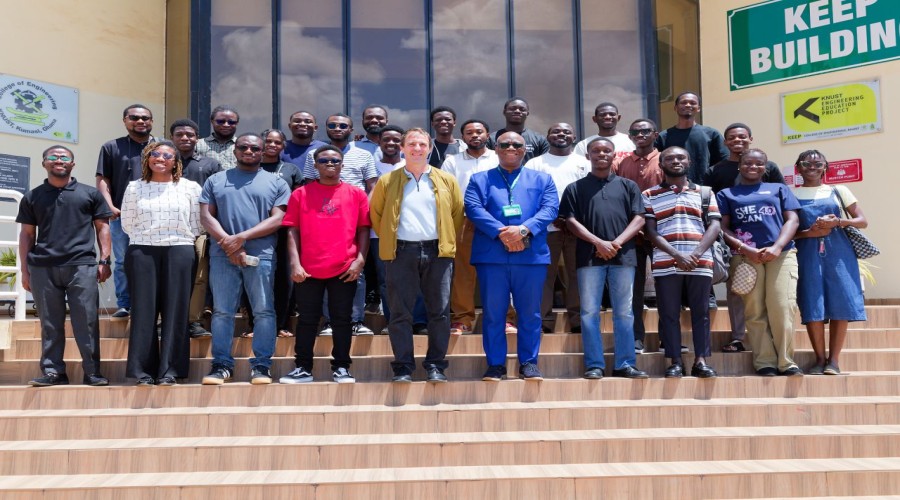
The presentation took place
during a seminar on CERN opportunities hosted by KNUST’s Responsible AI Lab
(RAIL) and Quantum Computing and Assistive Technologies Lab (QCAT).
Mr. Gastal explained that
while many quantum initiatives exist across CERN Member States and beyond, the
QTI was approved in 2020 with a distinct purpose: not to compete with existing
efforts, but to complement them. He described the initiative as grounded in
CERN’s existing expertise, with clearly scoped goals designed to maximise
impact.
He outlined four key areas
of quantum technology: quantum sensing, quantum simulation, quantum computing
and quantum communication.
Mr. Gastal announced that
KNUST is part of the QTI Hub, a collaborative network that enables students to
work on cutting-edge quantum applications at CERN. He also emphasised that CERN
is actively helping universities integrate quantum computing into their
curricula to ensure the next generation of scientists is equipped for the
quantum era.
He cited the Quantum
Materials Hackathon 2026, held at CERN, as an example of the hands-on,
collaborative opportunities available to partner institutions.
Prof. Jerry John Kponyo,
Principal Investigator and Scientific Director of RAIL and QCAT, challenged
researchers and students attending the seminar to move beyond discussions and
actively seize the opportunities presented.
"Work together, be
imaginative and creative, and the sky is only a stepping stone," Prof.
Kponyo said.