By: Van
Soul Addey
Ghana’s Minister for
Communication, Digital Technology and Innovation, Samuel Nartey George, has
presented 2,000 additional laptops to Kwame Nkrumah University of Science and
Technology (KNUST) as the government restructures the One Million Coders Programme
to focus on third- and final-year students preparing to enter the job market.
The announcement was made
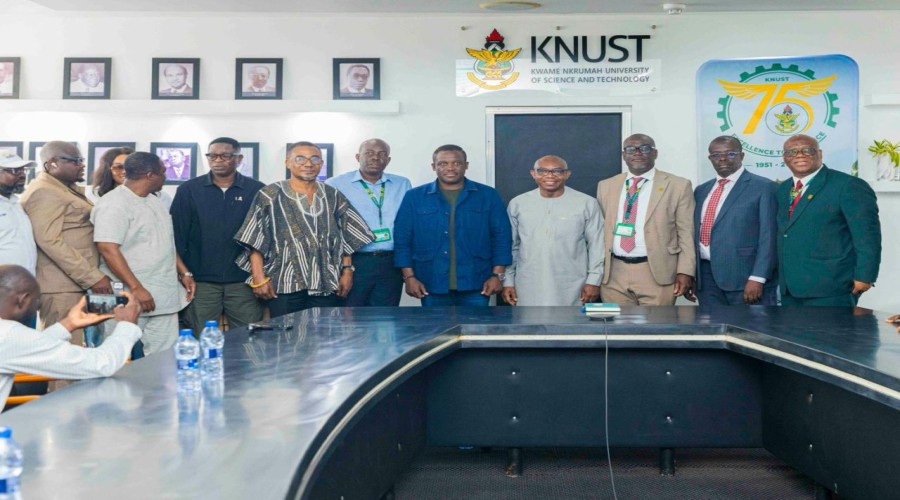
during the minister’s visit to KNUST in Kumasi, where he toured the Responsible
AI Lab (RAIL) and other research facilities and discussed the university’s role
in implementing Ghana’s National Artificial Intelligence Strategy.
The visit deepens the
Ministry’s partnership with KNUST as the country moves from AI policy
formulation to implementation, according to RAIL.
The One Million Coders
Programme originally targeted first-year students. Under the revised approach,
it will focus on third- and final-year students to better prepare them for the
job market upon graduation. The additional 2,000 laptops supplement an initial
donation of 500 units to the university.
Addressing Vice-Chancellor
Professor Christian Agyare and university leadership, George described his
return to his alma mater as nostalgic. He recalled arriving at KNUST as a
first-year Agricultural Engineering student in 2001 and expressed gratitude to
the university for shaping his career.
The minister said his first
two years in office had focused on establishing frameworks, including the
National AI Strategy, which was drafted by RAIL under the leadership of
Professor Jerry John Kponyo. President John Dramani Mahama launched the
strategy in April 2026, and it has now entered the implementation phase.
George emphasised that while
the government provides policy direction, academia has a central role in
executing AI initiatives. He identified RAIL as a key partner, particularly in
addressing the risk that artificial intelligence could deepen divides or contribute
to the extinction of indigenous African languages.
During the visit, the
delegation toured the Ghana Photonics and Optics Laboratory, RAIL and the KNUST
College of Engineering Innovation Center.