By:
Nana Appiah Acquaye
Kenya
has called for stronger regional cooperation, research and innovation to
address Africa’s interconnected challenges of climate change, food insecurity,
water scarcity and energy transition.
The
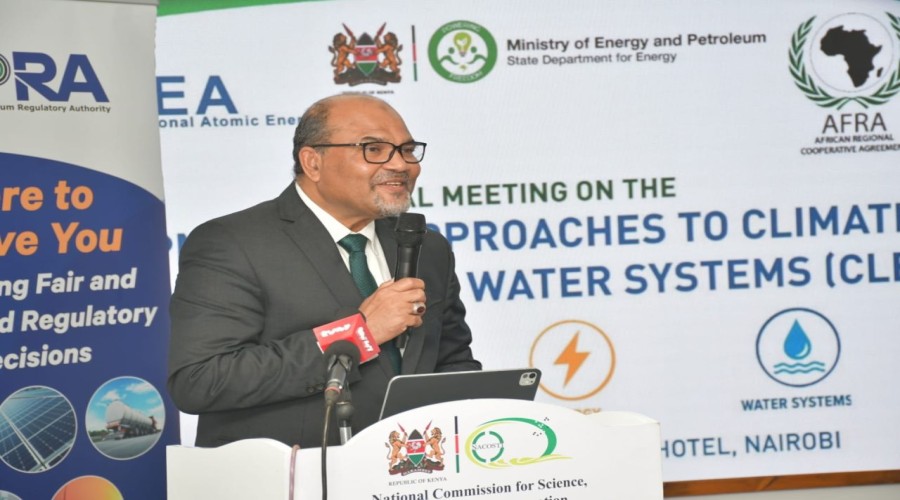
call was made by Prof. Shaukat Abdulrazak, Principal Secretary at Kenya’s State
Department for Science, Research and Innovation, during the opening of the
International Atomic Energy Agency (IAEA) Technical Cooperation Programme
regional meeting on Climate, Land Use, Energy and Water Systems (CLEWS) in
Nairobi.
Prof.
Abdulrazak emphasized the need for African countries to move beyond isolated
approaches and adopt integrated solutions that address multiple development
challenges simultaneously.
He
noted that climate change, declining food security, limited water resources,
energy transformation and rapid urban growth are closely linked, requiring
coordinated planning, innovation and evidence-based decision-making.
The
Principal Secretary highlighted the importance of leveraging emerging
technologies, including the peaceful applications of nuclear science and
technology, to support Africa’s sustainable development goals.
He
said nuclear-based technologies can contribute to areas such as energy
planning, climate-smart agriculture, biotechnology, mutation breeding and
isotope hydrology, offering new opportunities to strengthen food, water and
energy security across the continent.
Prof.
Abdulrazak noted that Africa’s growing population, which is projected to reach
nearly 2.5 billion people by 2050, requires accelerated investment in research,
innovation and technological solutions to build resilient economies.
He
pointed to international initiatives supported by the IAEA, including
Atoms4Food, Atoms4NetZero and other science-driven programmes, as important
platforms for knowledge sharing, institutional strengthening and the
development of solutions tailored to Africa’s unique needs.
The
CLEWS regional meeting brings together experts and stakeholders to explore
integrated approaches for managing climate, land use, energy and water systems
while strengthening cooperation among participating countries.