By: Nana Appiah Acquaye
Egypt has strengthened its
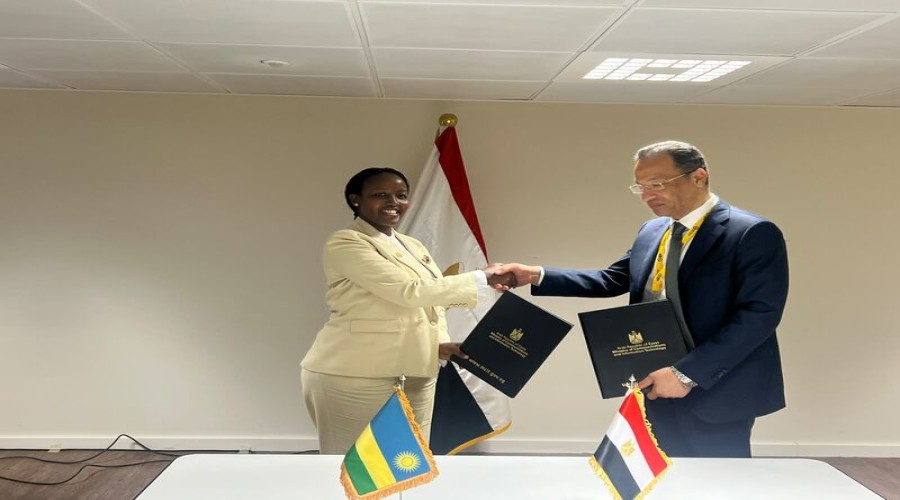
international digital cooperation agenda after signing a memorandum of
understanding (MoU) with Rwanda on artificial intelligence, digital
transformation and capacity building during the World Summit on the Information
Society (WSIS Forum 2026) in Geneva, Switzerland.
The agreement was signed by
Egypt’s Minister of Communications and Information Technology, Eng. Raafat
Hindi, and Rwanda’s Minister of ICT and Innovation, Paula Ingabire, following
bilateral discussions on advancing cooperation between the two countries in
emerging technologies and digital development.
The MoU focuses on
supporting the development of an African approach to responsible, inclusive and
development-oriented artificial intelligence. It also provides a framework for
implementing joint AI pilot projects in sectors including healthcare, agriculture,
local languages and government services.
The agreement further seeks
to strengthen collaboration among government institutions, universities,
research centres and innovation hubs in both countries, while promoting joint
positions on AI governance discussions at regional and global platforms, including
the African Union, the International Telecommunication Union (ITU) and the
United Nations.
The two countries will also
exchange experiences in digital public infrastructure, government service
platforms and interoperability standards.
The signing follows earlier
discussions between Egypt and Rwanda during Ingabire’s visit to Egypt in June,
where both sides explored opportunities to deepen cooperation in communications
and information technology.
During his engagements at
WSIS Forum 2026, Eng. Hindi also met Sudan’s Minister of Digital Transformation
and Communications, Ahmed Ghandour, to discuss cooperation in digital
transformation, artificial intelligence, digital skills development and infrastructure
advancement.
The two ministers discussed
opportunities to support Sudan’s digital workforce through capacity-building
initiatives in areas including artificial intelligence, cybersecurity and
personal data protection.
The Egyptian minister also
held talks with Amandeep Singh Gill, United Nations Under-Secretary-General and
Special Envoy for Digital and Emerging Technologies, on strengthening
cooperation in AI governance.
The discussions focused on
the transition from establishing AI governance principles to practical
implementation, including capacity building, interoperability and flexible
regulatory frameworks that enable developing countries to participate
effectively in shaping global AI governance.
Hindi highlighted Egypt’s
experience in AI governance, the implementation of its national AI strategy,
capacity-building programmes and ongoing work on AI impact assessments,
regulatory sandboxes and technical reviews through the Egyptian Centre for Responsible
Artificial Intelligence.
In another engagement, the
Egyptian minister met with Curtis Lindqvist, President and CEO of the Internet
Corporation for Assigned Names and Numbers (ICANN), where discussions focused
on preparations for the ITU Plenipotentiary Conference 2026, universal
acceptance of domain names and multilingual access to the internet.
The meeting also highlighted
Egypt’s role in supporting internet governance initiatives at regional and
international levels.
Hindi further held
discussions with Amir Gillen, Executive Director of Public Policy for the
Middle East, Eurasia and Africa at TikTok, on potential cooperation between the
National Telecommunications Regulatory Authority (NTRA) and the social media
platform.
The talks covered online
child protection, digital safety, capacity-building programmes and efforts to
promote science, technology, engineering and mathematics (STEM) content online.
The engagements were
attended by senior officials from Egypt’s Ministry of Communications and
Information Technology, including NTRA Chief Executive Officer Mohamed
Shamroukh, Assistant Minister for Digital Transformation Mahmoud Badawi,
Advisor for Technology Skills Development Hoda Baraka and other officials.