By: Nana
Appiah Acquaye
The global in-flight
connectivity (IFC) market is projected to experience sustained growth over the
next decade, with the number of connected aircraft expected to exceed 70,000 by
2035, according to a new industry report by Novaspace.
The report indicates that
IFC penetration will continue to rise across both commercial and business
aviation. In commercial aviation, adoption is forecast to increase from 48
percent to 72 percent, while business aviation penetration is expected to grow from
67 percent to 88 percent over the same period.
By the end of 2025,
approximately 39,500 aircraft were already connected globally, with business
aviation accounting for the majority share of connected fleets. Industry
analysts note that momentum is increasingly shifting toward commercial
aviation, which is expected to drive significant expansion in demand for
connectivity services.
The report highlights a
major technological transition underway in the sector, with non-geostationary
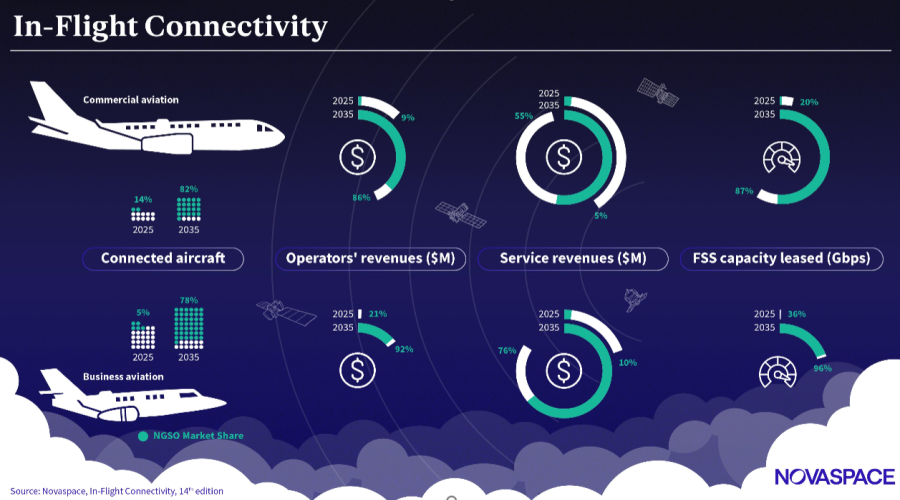
satellite orbit (NGSO) systems rapidly gaining market share. NGSO penetration
in commercial aviation has grown from 1 percent in 2024 to 14 percent in 2025
and is projected to reach 82 percent within the next decade, reshaping the
in-flight connectivity technology landscape.
This shift is expected to
drive a substantial increase in satellite capacity demand. Total capacity
leased for IFC services is projected to grow nearly nineteen-fold by 2035,
rising from 212 Gbps to 3.9 Tbps. NGSO-based solutions are forecast to account for
89 percent of total leased capacity by the end of the period, driven by their
ability to deliver high-bandwidth, low-latency and resilient connectivity
services.
Despite declining unit
pricing for capacity, the IFC market is expected to maintain strong revenue
growth. Total operator revenues are projected to reach 2.9 billion dollars by
2035, reflecting a compound annual growth rate of 16 percent. NGSO-driven demand
is expected to contribute 87 percent of total revenues by the end of the
forecast period.
The report further outlines
key developments across market segments, including service provider
competition, equipment innovation and regulatory trends. It provides a 10-year
forecast covering market size, capacity usage, aircraft connectivity adoption and
revenue dynamics across the IFC ecosystem.
Novaspace stated that the
findings underscore the growing importance of satellite-enabled connectivity in
transforming the passenger aviation experience and supporting the digital
evolution of the global aviation industry.