Presidents Doumbouya and Kagame open 7th Transform Africa Summit
Date: 2025-11-13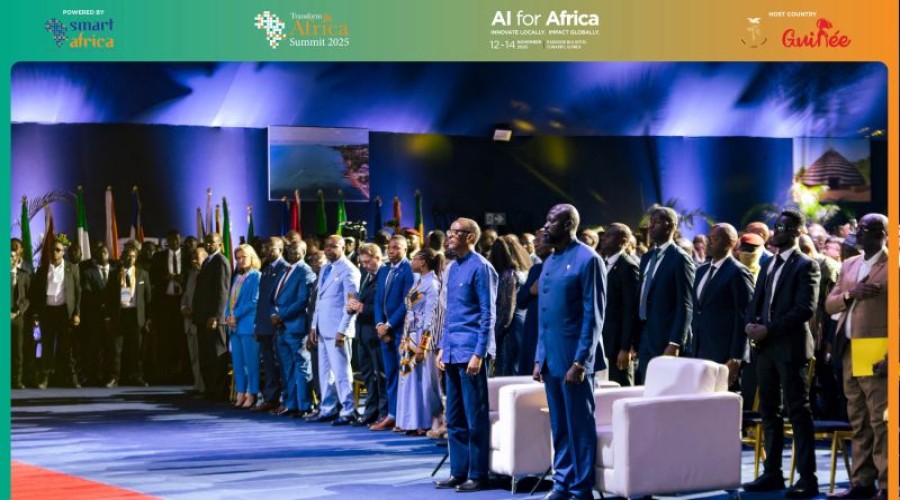
By: Nana Appiah Acquaye
The
7th Transform Africa Summit has officially opened in Conakry under the high
patronage of H.E. Mamadi Doumbouya, President of the Republic of Guinea, and
H.E. Paul Kagame, President of the Republic of Rwanda and Chair of the Smart
Africa Board. The ceremony featured an artistic performance celebrating
Africa’s creativity and was held under the theme “AI for Africa: Innovate
Locally, Impact Globally.”

In his opening address, President Mamadi Doumbouya outlined a clear vision of sustainable and inclusive development anchored in technology and innovation. He emphasized that Guinea’s long-term development strategy, Simandou 2040, places new technologies at the center of efforts to enhance national well-being and economic growth. “Aligned with my vision of a sustainable and responsible economic program for the next fifteen years, Simandou 2040, including its pillar 3, is dedicated to new technologies to improve the well-being of populations,” he stated.
President
Doumbouya’s remarks reaffirmed Guinea’s determination to build a strong,
opportunity-creating, and forward-looking digital economy, positioning the
country as a key driver of Africa’s transformation.

Rwandan
President Paul Kagame reflected on the continent’s digital journey since the
launch of the Smart Africa Summit in Kigali, commending the progress made while
urging continued focus on Africa’s priorities in an evolving technological
landscape. “The commitments made at the beginning of this journey still
stand. Yet today, we face a more complex and fast-evolving digital world. For
Africa, success will depend not only on how fast we deploy new technologies,
but on which problems we choose to solve,” he said.
He
noted that Africa’s readiness to harness artificial intelligence for
transformation must be guided by national AI policies and collaborative
frameworks such as the Smart Africa AI Fund, a step toward achieving
sustainable innovation and digital sovereignty.

Lacina
Koné, Director General of Smart Africa, emphasized that artificial intelligence
is redefining the way nations develop and societies evolve. For Africa, he
said, AI represents more than a technological advancement—it is a catalyst for
reimagining the continent’s future through local talent, ingenuity, and
innovation.
He
underscored the three foundational pillars of Smart Africa’s mission—digital
sovereignty, inclusiveness, and local innovation—highlighting the initiative’s
transformation from a consultative platform into a dynamic force accelerating
Africa’s policies, infrastructure, and digital transformation agenda.