Zambia hosts digital economy roundtable to accelerate inclusive digital transformation
Date: 2025-11-06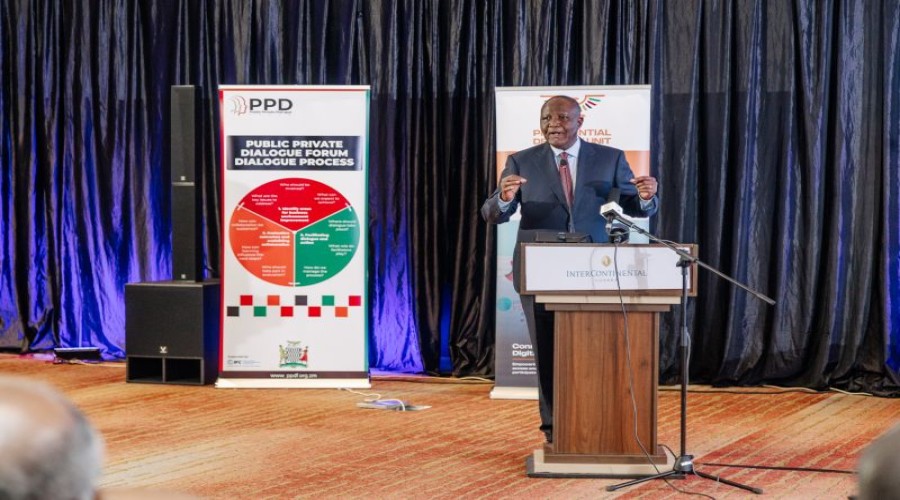
By: Kanto Kai Okanta
The
Government of Zambia has hosted the Digital Economy Roundtable (DERT) in
Lusaka, bringing together more than 60 institutions from the public, private
and development sectors to advance collaboration on the country’s digital
inclusion agenda. The event, held at the Intercontinental Hotel, was convened
by the Presidential Delivery Unit in partnership with the Ministry of
Technology and Science under the theme “Advancing Inclusive Digital
Transformation.”

Minister
of Technology and Science, Felix Mutati in his remark noted that the digital
economy continues to play a central role in Zambia’s economic growth and
national development, stressing that digital inclusion must empower citizens
across all sectors, including farmers, traders and students. Kusobile Kamwambi,
Head of the Presidential Delivery Unit, said the Roundtable reinforces
President Hakainde Hichilema’s commitment to ensuring a connected and equitable
Zambia, adding that the platform is designed to move beyond dialogue to
accelerate delivery and strengthen implementation pipelines.
During
the discussions, government highlighted key progress under the Digital
Inclusion Priority, including the ICT sector’s contribution to almost half of
Zambia’s 4% GDP growth in 2024, the rollout of more than 3,600 communication
towers leading to 13.5 million internet subscriptions, and the ZamFreeWiFi
programme, which has connected more than 8,500 users in public places across
four provinces in under a year.
Private
sector investment exceeding K1 billion has also played a significant role in
advancing connectivity, expanding network coverage to 96% of the population and
enabling digital skills training for more than 15,000 youth. Other
contributions include equipping schools and rural communities, connecting 430
public institutions to high-speed fibre, subsidising 4G smartphones to support
access, and training over 10,000 school staff in the use of digital tools.

Stakeholders
agreed on a number of outcomes following the Roundtable, including co-funding
digital hubs, expanding public Wi-Fi, scaling nationwide digital literacy
programmes, and implementing joint communication campaigns to enhance citizen
awareness. A 2026 Action Matrix with shared KPIs will be developed for
quarterly delivery reviews led by the PDU. The Public-Private Dialogue Forum
reaffirmed its commitment to ensuring that by 2030, 80% of Zambians have
internet access and digital literacy, with at least 20% actively participating
in the digital economy.