By: Nana
Appiah Acquaye
Africa’s
digital economies continue to face significant challenges in combating online
fraud, according to the newly released 2025
Global Fraud Index by Sumsub,
produced in collaboration with Statista,
CryptoUK, Digital Assets Association, Vixio Regulatory Intelligence, and
the MENA Fintech Association.
The
report, which analyzed fraud risk across 112
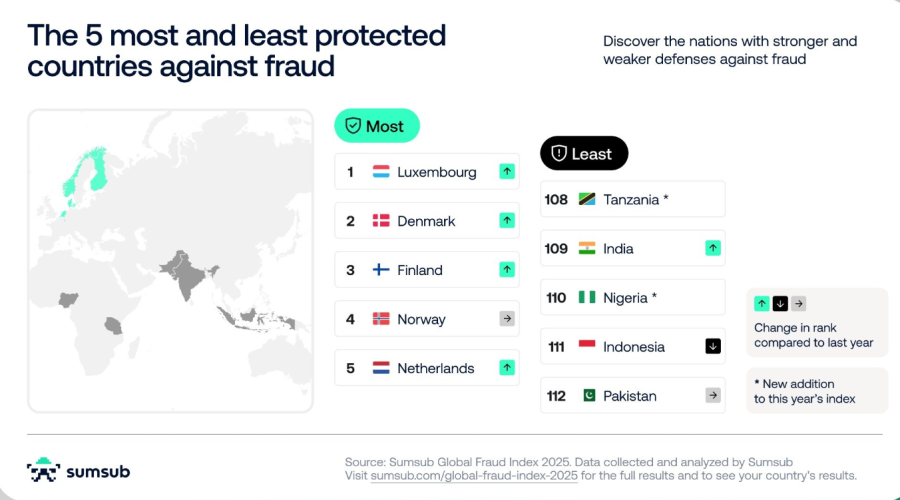
countries, reveals that several African nations including Nigeria, Kenya, Uganda, Tanzania, Rwanda, and
Ethiopia are among the 15
least protected countries against digital fraud globally.
Notably, Nigeria, Kenya, and Uganda
rank near the bottom of the index, highlighting persistent vulnerabilities in
fraud prevention and digital verification systems across the continent.
According
to the study, Pakistan
retained the last position for the second consecutive year, while Nigeria, Kenya, and Uganda joined
countries such as India, Bangladesh,
and Brazil in the lower tier of the rankings. This reflects
what experts describe as a growing global divide in digital fraud resilience,
largely influenced by governance, infrastructure, and data-sharing
capabilities.
“Fraud
protection isn’t about geography — it’s about governance,” said Timothy Owens, Senior Research Lead for Technology and
Telecommunications at Statista.
“Fraudsters are now using advanced AI tools, making constant monitoring and
collaboration between organizations critical.”
Europe
continues to dominate the top of the index, with Luxembourg, Denmark, and Finland
emerging as the most protected countries. The region accounts for the majority
of the top 15, while Singapore
— the only Asian country in that list — dropped from first place in 2024 to
tenth in 2025.
For
African economies, the findings underscore the urgent need for stronger fraud prevention frameworks,
AI-driven verification systems,
and cross-sector collaboration
to combat evolving cyber threats. Sumsub notes that this year’s report
incorporates new entrants from Africa, including Nigeria, Kenya, and Uganda, offering
a more comprehensive picture of regional performance.
The
Global Fraud Index leverages data from Sumsub’s
daily verification checks, combined with external sources such
as The World Bank, Transparency International, and Oxford Insights. It measures
exposure to digital fraud using four main analytical pillars based on “The
Fraud Triangle” — examining pressure, opportunity, and rationalization factors
that increase fraud vulnerability.
Sumsub
will further discuss the findings at its inaugural “What The Fraud (WTF) Summit” in Singapore, scheduled for November 19–20, 2025, aimed at
fostering public-private partnerships to strengthen global fraud prevention
efforts.
Full
details, including interactive maps
and country-by-country comparisons,
are available at sumsub.com/global-fraud-index-2025.