ITU Secretary-General Doreen Bogdan-Martin opens second Space Sustainability Forum in Geneva
Date: 2025-10-10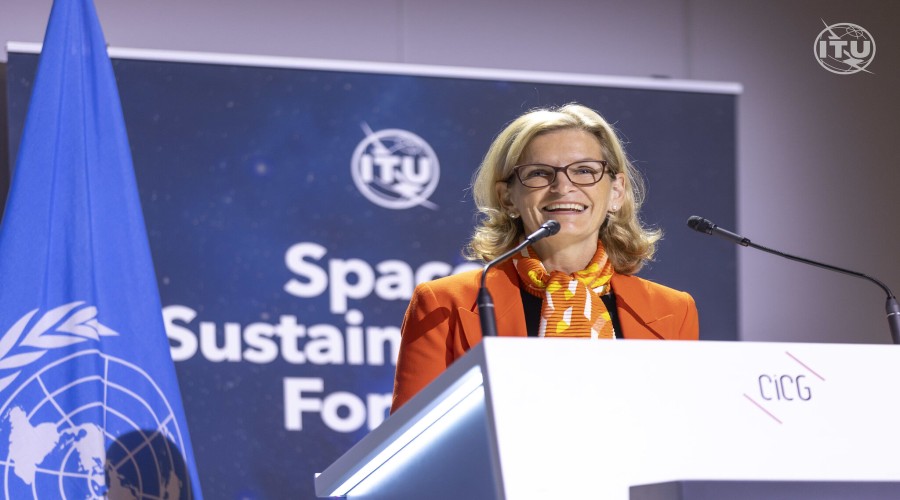
The
International Telecommunication Union (ITU) Secretary-General, Doreen
Bogdan-Martin, has opened the second edition of the ITU Space Sustainability
Forum in Geneva, calling for stronger international cooperation and practical
action to ensure that space remains a safe, inclusive, and sustainable
environment for future generations.
Speaking during World Space Week, Bogdan-Martin highlighted the growing momentum in global collaboration around space governance and sustainability since the inaugural forum last year. She underscored ITU’s role in advancing coordination, transparency, and practical tools to manage the rapid expansion of space activities.
“We
meet during World Space Week to celebrate how space science and technology can
improve human life and advance sustainable development,” she said, adding that “space is a
unifier” that demands shared responsibility among governments, industry, and
international organizations.

Bogdan-Martin
announced several new ITU initiatives designed to strengthen global space
cooperation. Chief among them is the ITU
Space Sustainability Gateway, a centralized platform providing
contact points across administrations, operators, and space agencies, as well
as access to technical resources, best practices, and databases on responsible
space operations. Developed in collaboration with the United Nations Office for
Outer Space Affairs (UNOOSA), the Gateway aims to enhance information sharing
and promote responsible post-mission disposal practices.
The
ITU has also launched SpaceConnect,
a series of online discussions that explore key issues such as low-Earth orbit
(LEO) fundamentals, authorization, ground networks, and the humanitarian impact
of space technologies. Eight episodes have already been released, with more
planned for the remainder of the year.
Bogdan-Martin
noted the increasing prominence of space-related issues at global platforms
such as the G20 Digital Economy Ministers Meeting, the Global Cybersecurity
Forum, and the UN General Assembly. She referenced the UN Pact for the Future and the Global Digital Compact, both of
which emphasize space traffic coordination, debris management, and equitable
access to satellite orbits as essential elements of sustainable development.
“This
year is all about action,” she emphasized. “For ITU, that means securing a reliable,
interference-free radio environment that keeps your space investments safe and
sustainable.”
Pre-forum
workshops, held in partnership with Saudi Arabia’s Communications, Space and
Technology Commission and the Digital Regulatory Academy, provided participants
with hands-on training on space sustainability and regulatory issues. The event
also features a live demonstration of a space traffic coordination system
offering free safety services to civil and commercial operators — an example of
how public and private capabilities can align to enhance space safety.
Bogdan-Martin
drew attention to the scale of investment and growth in the global space
economy, noting that over USD 60 billion has been invested in the sector in the
past decade, with 80 per cent occurring in the last five years. The space
economy, she said, could reach USD 1.8 trillion by 2035, underscoring the need
for disciplined coordination and spectrum management to prevent interference
and maintain operational safety.

“As
more countries establish space agencies and engage in space activities, we must
work together to uphold our responsibility as stewards of spectrum on Earth and
in space,” she said.
“We must keep the process fair, and keep the orbital and spectrum environment
usable for all.”
Concluding
her remarks, the ITU Secretary-General urged the international community to
redouble efforts in communication, coordination, and sustainability to ensure
that the benefits of space are shared equitably across the world.
“If
we want the benefits of space to reach all people,” she said, “we need better
communication, closer coordination, and stronger sustainability efforts.
Together, we can make space a foundation for resilience and inclusive global
progress.”
The
two-day ITU Space Sustainability Forum 2025 brings together government
officials, space agencies, private sector leaders, and experts to discuss the
future of sustainable space operations and cooperation in an increasingly
complex orbital environment.
By:
Nana Appiah Acquaye