In November 2024, Ghana took a bold step
toward a fairer, faster, and more modern telecom sector by licensing the first
wholesale shared network for nationwide 4G and exclusive 5G service.
This neutral, wholesale-only platform, led
by special purpose vehicle (SVP) Next-Gen Infrastructure Company (NGIC), is
intended to fix long-standing market problems: poor coverage quality, unequal
investment incentives, and the outsized dominance of one operator—MTN Ghana.
But months after launch, the dominant
player and only significant market power (SMP), appears reluctant to come on
board.
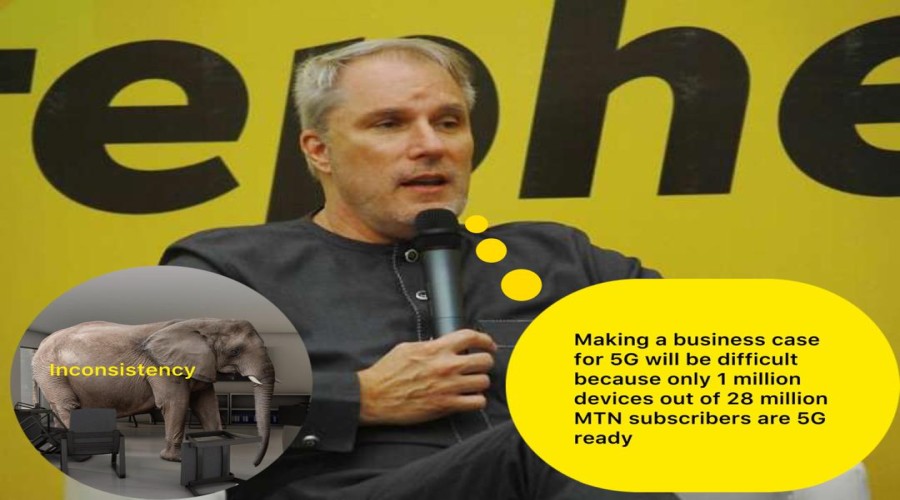
MTN Ghana’s CEO, Stephen Blewett, recently
questioned the business case for 5G in Ghana, citing low adoption of 5G-capable
devices among MTN's 28 million customers. At his first ever media engagement in
April this year, he claims MTN has only one million 5G-capable devices on its
network and that is not enough to make a business case. This stance raises
crucial questions—not just about MTN’s strategy, but about the credibility of
government policy, the success of the shared network model, and the future of Ghana’s
digital economy.
Blewett did say that MTN “will surely
participate in 5G” in the future, either via NGIC or another arrangement. But
for now, they are “waiting on the Minister for direction.”
Watch the video below: https://youtu.be/e6-m6tolTYc?si=HrDvqk5Ff3eoNKkp
His comments are particularly similar to
what a former Vodafone
Ghana CEO, Yolanda Zuleka Cuba said about 4G in August 2016, and also what
the onetime Tigo
Ghana CEO, Carlos Carceres said about Mobile Number Portability (MNP)
policy in February 2011. Eventually, the two companies lost out heavily on
those two policies - 4G and MNP.
NGIC and Ghana’s 5G Policy
To address Ghana’s fragmented 4G rollout
and tackle market imbalance, the government awarded NGIC a 10-year license
(2024–2034) to serve as the single wholesale platform for 4G (non-exclusive)
and 5G (exclusive) services nationwide.
Under this model:
- 4G is shared wholesale
(any operator can build, but NGIC is meant to offer a neutral, cheaper,
high-quality wholesale alternative).
- 5G is exclusive to NGIC
for wholesale—no other company can build standalone 5G networks during
this period.
The idea is to reduce duplication of
infrastructure, promote fair competition, and expand high-speed
broadband to underserved areas.
Indeed, the Minister for Communication,
Digital Technology and Innovation, Sam George, did state at his Q2 2025 media
briefing that the shared model is "a deliberate policy shift to
address infrastructure implications, lower data cost, and accelerate universal
5G access for all Ghanaians." In fact, while he was in opposition
as head of John Mahama's Manifesto Committee on Communications and Digital
Technology, Sam George told Techfocus24 that the NDC fully supports the shared
model for 5G rollout because it was contained in the NDC
2020 Manifesto.
Also Read: NDC
manifesto supports 5G shared network – Sam George
So, if the MTN Ghana CEO says he is waiting
for a policy direction from the Ministry, that policy direction was clearly
articulated by the Minister as recently as July 3, 2025.
At this stage, AT Ghana and Telecel
Ghana have both been granted connecting entity licenses to connect to NGIC
because they applied for it. MTN has still not even bothered to apply.
Even though no specific deadline has been
given for the anchor telcos to connect to NGIC, the regulator, National
Communication Authority (NCA) has clearly communicated a policy position that
ISPs (internet service providers) will only be considered for connecting entity
approval six months after NGIC begins commercial operations.
MTN's refusal to apply for a connecting
entity license raises a crucial regulatory question: If the dominant
operator controlling almost 80% of mobile data market share doesn’t
participate in the shared 5G platform, can Ghana’s digital
transformation succeed?
Fact Check: Hasn’t MTN Wanted 5G Before?
Yes they have—and that’s what makes the
current stance so puzzling.
In 2021, MTN Ghana
proudly announced it had 1,322 sites ready for 5G rollout. MTN then lobbied
the government for a 5G license. In fact, MTN
Group’s CEO even personally pressed President Akufo-Addo for 5G approval at
the World Economic Forum in New York.
This was four years ago. At that time,
there were surely fewer than one million 5G-capable devices on the MTN network
and in Ghana as a whole.
So why is it that, in 2025—when more 5G
devices are on MTN and in the market, and when a cheaper shared model is
available—that the business case is suddenly “not there”?
Why in MTN suggesting to Ghanaians that
seeking to acquire a standalone 5G license at a higher price to serve fewer 5G
customers, made a better business case in 2021, than serving more 5G customers
under a relatively cheaper shared model now?
The logic doesn’t seem consistent, unless
the current MTN Ghana CEO is suggesting to Ghanaians that his predecessor,
Selorm Adadevoh, and Group CEO, Ralph Mupita's decision to lobby the government
for standalone 5G license years back was a bad business decision.
More Confusion from MTN
In fact, just last week, barely five months
after Blewett's confusing comment, the MTN Group CEO, Ralph Mupita was reported
to have told journalists that MTN has held discussions with the Ghana
government and regulators, setting the stage for a rollout
of 5G on MTN Ghana soon. This announcement by the Group CEO deepens the
confusion further, as to whether MTN has suddenly found a business case for 5G
now, or it is just a matter of MTN not being interested in the current
government policy of a shared model for 5G rollout in Ghana.
Mupita recent comments does not only expose
the inconsistencies in MTN's position on the 5G conversation in Ghana, but also
exposes a worrying inconsistency in government's policy. It is important to
note that NGIC has a 10-year exclusivity to 5G rollout in Ghana, and the
Minister has stated clearly that the shared network model is a deliberate
policy shift for very good reasons. So, if government is truly engaging with
MTN on a possible standalone 5G license, that flies in the exclusivity clause
in NGIC’s licensing terms. It also hampers the confidence of investors who are
tracking these developments closely.
What MTN Knows (But Isn’t Saying Out Loud)
MTN is one of Africa’s most sophisticated
telecom operators. Its Group strategy—“Ambition 2025”—is built around moving
from being just a telecom company to a technology company.
One of its pillars is Enterprise Solutions.
And the real value of 5G isn’t only
in consumer handsets—it’s in enterprise and industrial uses such as
- Mining and oil & gas
- Logistics and smart factories
- AI-powered agriculture
- Advanced financial services
- Healthcare and education etc..
Per this writer's understanding, these
sectors need ultra-low latency, high-capacity networks. That is the real
5G business case. In fact, Mupita acknowledged this during his recent media
engagement in Ghana.
MTN knows this better than anyone—which
makes the Ghana CEO’s public argument about the number of 5G-capable devices
ring hollow and confusing.
Policy Confusion—and a New Extension
Another confusion comes from the
government’s own mixed signals in managing spectrum and competition.
Earlier this year, the Ministry
granted MTN additional 4G spectrum under a “technology neutrality”
policy—but crucially, that allocation did not allow MTN to use it for 5G.
Officially, this extra 4G capacity was meant to address pressing network
quality issues, especially urban congestion.
While this move is intended to deliver
short-term relief for consumers, it also created the perception that the
government was willing to make regulatory concessions to its dominant
player—even while promoting an NGIC-led shared network vision for 5G.
Again, that inconsistency undermines
confidence in the policy and sends a confusing signal to investors and
competitors.
Meanwhile, recognising deployment delays
and technical challenges, the Minister for Communications, Digital Technology
and Innovation, Sam George, recently granted an extension
for NGIC to complete its network rollout and become fully operational. He
specifically stated that NGIC is expected to rollout at least 50 5G sites in
Accra and Kumasi by Q4 this year.
But there’s a critical gap: the Minister did not set a clear deadline for the anchor telcos to
connect to NGIC’s wholesale platform once it is ready.
This is important. Without a firm
mandate for the retail operators to onboard NGIC’s wholesale service, the consumer
experience remains unaddressed. NGIC might be ready to deliver affordable
shared 4G and exclusive 5G capacity—but unless the MNOs and ISPs are required
to use it on clear timelines, the policy’s benefits could stall at the
wholesale level, never reaching end users.
All these, coupled with the fact that the
Minister only casually asked MTN to apply for connecting entity license and
join the NGIC "if they so wish", and the minister's threat to review
the terms of the NGIC license if they fail to meet the Q4 2025 deadline, seem
to suggest that there is a grand agenda to make NGIC fail just to justify why
MTN should be given a standalone 5G license.
Also Read: Elephant
in the Room: Why Ghana missed the June deadline for 5G rollout
Allegations of Vendor Pressure and
Anti-Competitive Tactics
Meanwhile, multiple industry sources allege
that certain vendors—companies providing managed services to several
telcos—have been pressured not to work with NGIC.
Some say they’ve been warned they could
lose contracts with big players (including a telco and certain infrastructure
companies) if they support the shared wholesale rollout.
If true, this is classic anti-competitive
behaviour that would warrant serious regulatory investigation.
Even more troubling, some insiders claim
lobbying efforts have been made to delay development finance institution (DFI)
funding for NGIC, suggesting that the policy environment might shift back to
favouring standalone 5G licenses in the future.
Why Every Ghanaian and Stakeholder
Should Care
This isn’t just a fight among telecom
giants. It affects all of us.
If MTN is allowed to “wait it out”
indefinitely, and if vendors and smaller operators are pressured into silence
or delay, Ghana risks:
- Higher mobile data prices
• Slower, fragmented 5G rollout
• A wider digital divide between urban elites and rural areas
• A creeping private-sector monopoly over national telecom infrastructure
Telecoms are the backbone of our digital
economy. Letting one player dominate unchecked threatens competition,
innovation, investment—and ultimately, the welfare of every Ghanaian consumer
and business.
What Needs to Happen Now
- The Ministry and NCA must enforce policy coherence: The NGIC license is a legal and strategic framework designed
to deliver affordable, nationwide 4G and exclusive 5G through shared
infrastructure. It must be consistently enforced—or transparently amended
through due process. Mixed signals about spectrum policy and technology
neutrality undermine investor confidence and the entire shared-network
strategy.
- Deadlines for operator onboarding must be clear: Government cannot simply declare NGIC “ready” while leaving
retail service in limbo. The Ministry and NCA should set binding,
enforceable timelines for mobile network operators (MNOs) and ISPs to
connect to the platform so consumers actually see the benefits.
- The NCA must ensure a fair, transparent pricing regime: As regulator, the NCA is responsible for approving NGIC’s
wholesale pricing to ensure it is affordable, competitive, and
incentivises uptake—while guaranteeing quality of service. This is
essential for avoiding monopolistic pricing and ensuring the policy meets
its equity goals.
- NGIC must deliver on coverage and quality commitments: NGIC itself has to earn trust. It must ensure its wholesale
service is reliable, nationwide, and technically robust, with clear
service-level guarantees. Without nationwide coverage and quality
infrastructure, operators will have an excuse to delay onboarding or lobby
for alternative licenses.
- MTN must clarify its position: Is
it simply stalling to renegotiate the rules, or is it genuinely committed
to Ghana’s shared 5G future? Given its market dominance, MTN’s intentions
matter enormously for policy credibility and industry planning.
- Allegations of vendor intimidation must be investigated: Regulators should urgently investigate claims that vendors are
being threatened or penalised for working with NGIC. Procurement integrity
is non-negotiable for building trust and ensuring true neutrality.
- Ghanaians and all Stakeholder must stay informed and engaged: Ultimately, this is not just an industry dispute. It’s about
whether Ghana will build a fair, competitive, future-ready telecom
market—or cede control to private monopolies. Public scrutiny and debate
are essential to hold all parties accountable.
- No response from MTN
It is only fair to state that, even though
the MTN Ghana CEO made his position clear in the video insert above, this
writer still wrote to MTN Ghana seeking further clarification of his comments.
The request was submitted to MTN on July 7, 2025, but till date (more than two
months later) MTN is yet to respond to the request, even after several follow
ups.
NGIC's Response
This writer also wrote to NGIC seeking its
response to concerns raised about its readiness. Unlike MTN, the company gave
three very key responses to which the public can hold them going forward:
By Q4 this year, NGIC will switch on 50 live 5G sites in Accra
and Kumasi, all connected to a new cloud-based 5G core network. In simple
terms, this ‘core’ is the brain of the system
- On partnerships, NGIC has signed agreements with tier-one
equipment providers such as Nokia, is in discussions with cloud and data
centre partners to enable edge computing, and has advanced talks with
development finance institutions (DFIs) to support the first phase of
rollout.
- Importantly, NGIC has now closed a landmark agreement with
Ghana’s leading TowerCo (ATC Ghana). This gives NGIC ready access to
thousands of existing tower sites nationwide, allowing them to expand
beyond Accra and Kumasi without wasting time or money duplicating
infrastructure.
Final Thoughts
This is a defining moment for Ghana’s
telecom future.
We can choose to build a fairer, more
competitive, future-ready network—or slide into monopoly, fragmentation, and
policy confusion.
MTN is a central player in this story. But
so are government regulators, the Ministry, vendors, investors—and you, the
Ghanaian consumer.
Today, government is having to use what
many have described as “bullying tactics” to try and whip South African Pay-TV
monopoly, Multichoice (DSTV) in line over prices. Meanwhile, there is a bigger
threat of a monopoly in the telecom industry and government seem to be
encouraging it. A sequel to this article will look at that matter in detail,
plus the implications of an AT Ghana and Telecel Ghana merger for the shared 5G
network model.
Let’s all put Ghana first.
By: By Samuel Dowuona
(The author, Samuel Dowuona, is a
multiple award-winning telecoms and technology journalist. He can be reached on
dowuonasamuel24@gmail.com)