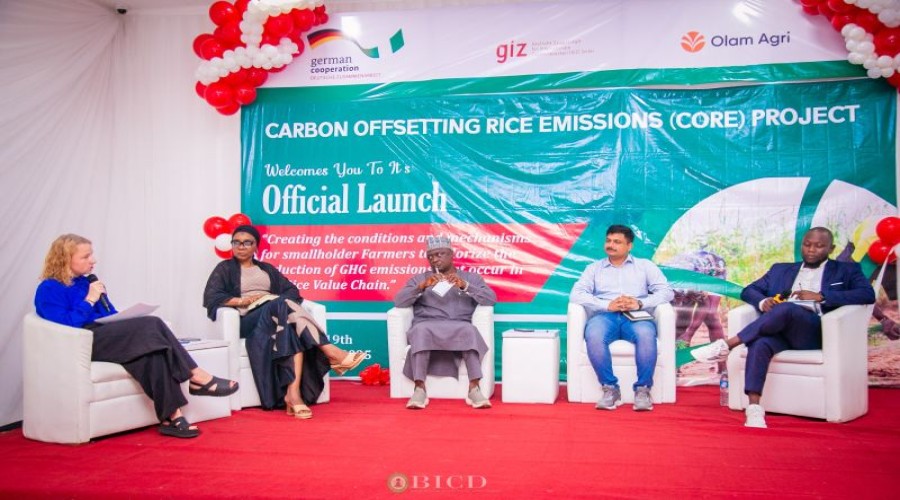
Germany has
officially initiated the Carbon Offsetting Rice Emissions Project in Nigeria,
marking a significant step toward sustainable agricultural development and
climate change mitigation. The innovative program, funded by the German Federal
Ministry for Economic Cooperation and Development and implemented by GIZ in
partnership with Olam Agri, focuses on empowering smallholder rice farmers with
climate-smart production techniques.
The CORE
project addresses critical challenges facing Nigeria's agricultural sector by
enabling farmers to reduce carbon emissions while simultaneously increasing
yields and lowering production costs. This comprehensive approach moves beyond
environmental considerations to deliver substantial economic benefits,
including enhanced market integration and greater gender inclusivity within
farming communities.
Deputy Head of
Mission at the German Embassy in Abuja, Johannes Lehne noted the project's dual
purpose during the launch ceremony. "The CORE project addresses the
dual challenge of food insecurity and climate change," he stated,
noting the initiative's alignment with Nigeria's national climate objectives
and sustainable development goals.
The urgency of
such interventions was highlighted by Olamide Fagbuji, Senior Special Assistant
to the President on Climate Change, who revealed that Nigeria suffers
approximately $100 million in annual losses due to climate-related flooding.
This economic impact underscores the critical need for adaptive agricultural
practices that can withstand changing environmental conditions.
A key
innovation of the CORE project involves connecting smallholder farmers to
carbon markets, creating new revenue streams while promoting environmentally
responsible farming methods. This market-based approach not only incentivizes
sustainable practices but also contributes to Nigeria's broader 2030 climate
investment targets.
The CORE
project represents Germany's ongoing commitment to global climate action and
sustainable development, particularly in agricultural sectors that are both
vulnerable to climate change and significant contributors to greenhouse gas
emissions. Through this initiative, smallholder rice farmers in Nigeria gain
access to advanced farming techniques that can transform their productivity and
environmental impact while improving their economic resilience in the face of
climate challenges.
By: Nana Appiah Acquaye