Ghana signs space cooperation agreement with Japan at TICAD9
Date: 2025-08-25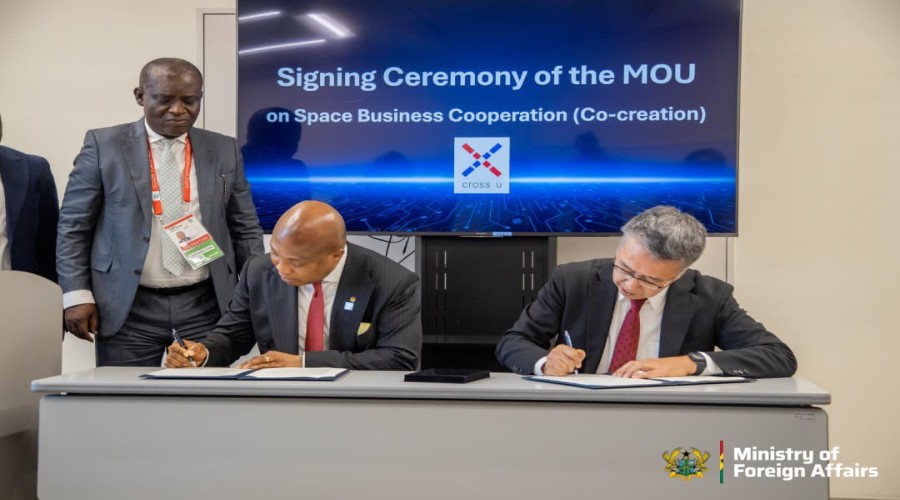
Ghana has taken a monumental leap in technological advancement through a groundbreaking space agreement signed with Japan during President Mahama's working visit to the Ninth Tokyo International Conference on African Development. The landmark agreement, formalized by Ghana's Minister of Foreign Affairs and Regional Integration, Samuel Okudzeto Ablakwa and Japanese counterparts, establishes a strategic partnership to leverage space science for national development.
This historic
agreement marks Ghana's most significant advancement in space technology
cooperation to date, positioning the country to harness Japanese expertise in
satellite technology, earth observation, and space science applications. The
partnership will enable Ghana to utilize space-derived data for critical
sectors including agriculture, environmental monitoring, disaster management,
and urban planning.

The space cooperation framework represents a sophisticated technological partnership that moves beyond traditional development assistance. It provides Ghana with access to cutting-edge satellite technology and technical knowledge transfer that can support evidence-based policymaking and resource management. The agreement specifically focuses on applying space technology to address practical development challenges while building local capacity in space science and technology.
During the
signing ceremony, Minister Ablakwa emphasized how this partnership honors the
legacy of Japanese scientist Dr. Hideyo Noguchi, who sacrificed his life for
Ghana nearly a century ago. "Ninety-eight years after Noguchi's
extraordinary dedication to our nation, Ghana-Japan relations have reached
their pinnacle through this advanced technological cooperation,"
Ablakwa stated.
The space
agreement forms part of a comprehensive package of partnerships secured during
TICAD9, which includes training for 300,000 Ghanaian youth in artificial
intelligence, biotechnology, and green technologies. This integrated approach
ensures that space technology development is supported by a broader ecosystem
of technical skills and knowledge.
The partnership will facilitate technology transfer and capacity building in satellite development, remote sensing, and space data analysis. Japanese institutions will collaborate with Ghana's Space Science and Technology Institute to develop indigenous capabilities in space technology applications, creating opportunities for Ghanaian scientists and engineers to work alongside international experts.

This agreement positions Ghana as a regional leader in space technology application in West Africa, with potential benefits extending to neighboring countries through data sharing and technical cooperation. The space technology partnership demonstrates Japan's confidence in Ghana's technological ambitions and institutional capabilities to effectively utilize advanced space technology for development purposes.
By: Nana Appiah Acquaye