Across Ghana, over 5,400 basic schools still operate under trees or
in makeshift structures, leaving thousands of children without shelter, desks,
or trained teachers. As the world advances in educational technology, many
Ghanaian children remain in dire conditions—highlighting deep inequalities in
access to quality education.
Recent data shows that 1.2 million children aged 4–17 have never
attended school, with 30 dropping out each day. A key factor is the shortage of
accessible, well-equipped schools, especially in rural areas. Critics point to
skewed budget priorities: in 2023, only 20% of the Ministry of Education’s
budget went to basic education, while tertiary institutions and administrative
costs received the lion’s share.
Advocates estimate GHS 3.5 billion is needed to end the “schools
under trees” crisis. They argue that better use of the Ghana Education Trust
Fund (GETFund) could have resolved the issue between 2021 and 2024. Now, with
Parliament approving GHS 800 million for basic education in 2024—the highest in
seven years—there’s renewed hope. Civil society groups are urging the
government to prioritize deprived communities and redirect oil revenues toward
foundational education.
Beyond the numbers are real children whose dreams are at stake
because of all the odds stacked against them.
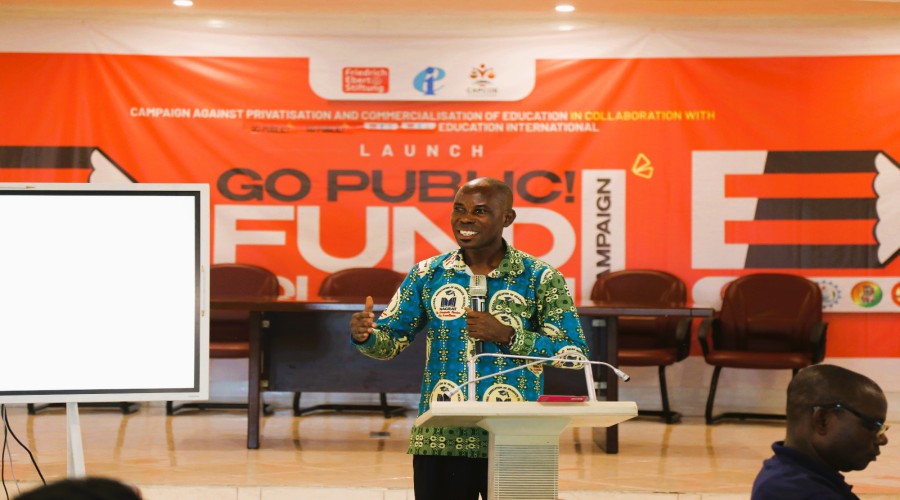
There is growing consensus among civil society organizations such
as Campaign Against Privatization and Commercialization of Education (CAPCOE),
EDUWATCH, Education International (EI) and the Frederich Egbert Foundation
(FES) that, ending the practice of teaching and learning under trees is not a
luxury—it is a necessity. As Ghana positions itself as a leader in West Africa,
calls are mounting for the country to put its youngest citizens first.
Education, they say, is a right—not a privilege—and the time to act is now.