Global digital cooperation in focus as 20th Internet Governance Forum concludes in Norway
Date: 2025-06-29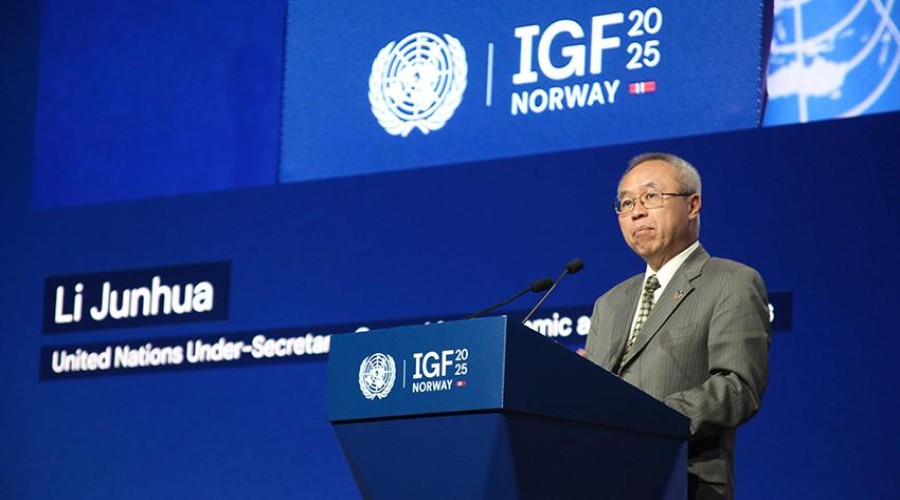
The 20th annual Internet Governance Forum (IGF) concluded last week in Lillestrøm, Norway, celebrating two decades of advancing open, inclusive, and secure digital development. Hosted by the Government of Norway in collaboration with the United Nations Department of Economic and Social Affairs (UN DESA), this milestone gathering brought together more than 9,000 participants onsite and online from across the globe, including policymakers, civil society leaders, academics, youth, and the private sector.

In his opening
remarks earlier in the week, United Nations Secretary-General António Guterres
reflected on the significance of the occasion, noting: “Two
decades ago, digital cooperation was a bold aspiration. Today, it is an
absolute necessity – and a shared responsibility.” He also highlighted the
recent adoption of the Pact for the Future and the Global Digital Compact,
which recognized the Internet Governance Forum as the primary multistakeholder
platform for digital governance issues.
This year’s IGF welcomed high-level participation from
governments, especially from Africa and the Global South, alongside
representatives from leading technology companies including Meta, OpenAI, and
TikTok. Actor and producer Joseph Gordon-Levitt also took part, engaging in
discussions that explored the creative and ethical dimensions of artificial
intelligence. Through its inclusive multistakeholder format, the IGF provided a
trusted platform for open dialogue and cooperation on the world’s
most pressing digital issues.
In his closing
statement, Li Junhua, United Nations Under-Secretary-General for Economic and
Social Affairs, emphasized that as we look toward the General Assembly’s review of the IGF mandate this December, “We have a critical opportunity to reaffirm and
re-energize the IGF’s role as the global
home for inclusive dialogue and digital policies.” He further underscored
that “ensuring safe and secure deployment
of digital technologies is a shared responsibility—and a critical priority—for
the global multistakeholder community. We must deliver it.”
Held under the
overarching theme “Building
Digital Governance Together,” the Forum featured more than 260 sessions over
five days. Discussions covered critical areas such as data governance, emerging
technologies, cybersecurity, universal connectivity, digital rights, and the
future of global digital cooperation.

Karianne Tung,
Minister of Digitalisation and Public Governance of Norway, remarked in her
closing statement, “We are proud that this year’s Internet Governance Forum,
hosted in Norway, has laid a strong foundation for the forthcoming WSIS+20
process. A continued, permanent, and strengthened IGF mandate will be vital in
shaping the future of global digital governance. I extend my sincere gratitude
to all stakeholders who engaged in vibrant, thoughtful discussions here in
Norway, and who played a key role in the success of IGF 2025.”
A key outcome of
the Forum was the Lillestrøm
IGF Messages, which reflect shared priorities and recommendations
from IGF participants. These Messages offer actionable guidance for
policymakers, focusing on digital governance, human rights online, the
opportunities and risks of digital innovation, and the role of digital
technologies in advancing peace, sustainability, and development.
Throughout the
week, participants underscored the urgent need to address rising challenges in
the digital landscape. Concerns were raised about the erosion of digital trust,
driven by the rapid spread of misinformation, disinformation, and malicious
content. The emergence of generative AI has made it easier to produce
convincing yet false content, exacerbating the risks—particularly for young
people who increasingly rely on digital platforms for information and
interaction.