On
November 1, 2024, there was a grand event at the La Palm Royal Beach Hotel,
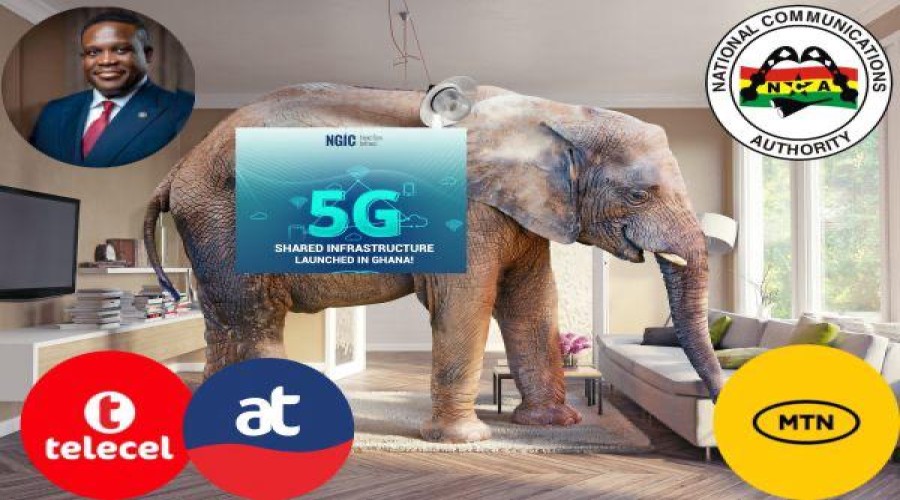
which marked the ceremonial launch of Ghana's first shared 4G/5G network
under an exclusive 10-year license granted to Next Generation Infrastructure
Company (NGIC). But it was not yet an operational launch, which would have
meant the network was actually live for public consumption from that date. As
we speak today, it has been six months since the "launch" but there
is still no live public 5G network in Ghana yet.
Speaking
of live 5G network, the then Minister of Communications and Digitalization,
Ursula Owusu-Ekuful, under whose tenure the ceremonial launch was done, gave a
December 2024 deadline for all three telcos in Ghana - MTN, Telecel and AT
Ghana, to rollout live 5G networks for public consumption. In fact, she said
the network was ready and so if by December 2024, any telco was not offering
5G, then customers should question that telco. In spite of that bold statement,
six months have passed and we still don't have a live 5G network anywhere in
Ghana yet.
Initially,
the deadline for the live rollout was extended to January 2025, then to May
2025. Recently, new sector Minister, Sam George made a public announcement that
the sole wholesaler for the 4G/5G network in Ghana, NGIC has assured him that
5G will go live in Ghana in June 2025, which is this month. He then stated
that he
is going to hold them to that deadline, and if they fail there will be
consequences, which may include a possible review of the 10-year exclusive
licensing terms. The Minister did state that he is not a fan of terminating
contracts and licenses, particularly because such actions have financial
consequences for the state. But he will not hesitate to review the terms of the
license if it becomes necessary.
NGIC
itself has not made any public statement as to when the network will go live,
but even if we took the Minister's word for it, the month of June is gone, and
we still don't have live public 5G network anywhere in Ghana. So, what are the
operational and regulatory hurdles which have been in the way of 5G going live
in Ghana?
Operational issues
Tower rollout
According
to Honourable Sam George, NGIC assured him that by June they would have rolled
out at least 350 cell sites, comprising of 200-250 sites in Accra and 100-150
sites in Kumasi, out of which at least 50 will be 5G sites, adding that he is
looking forward to nothing less than what they promised. But at the last count
NGIC had rolled out only up to 22 cell sites mainly in Accra and Kumasi, which
is far cry from the promise, and woefully inadequate to ensure a meaningful
impact across the country.
But
we are reliably informed that all the equipment needed to rollout the 350 cell
sites are in country and have been warehoused here, waiting for a number of
regulatory approvals to make their rollout worth the while of the stakeholders.
Rolling out such equipment and managing them cost a lot of money in the form of
monthly fees and utility bills. A typical example of such bad business decision
was when Glo first came to Ghana - they rolled out cell sites to cover 90% of
the country even though there was no real guarantee of customer presence across
the country. In the end they had to decommission a lot of the sites even before
the company finally collapsed. So, if regulatory approvals for industry players
to connect to the shared platform and use the sites are still pending, it would
not make commercial sense to roll them out immediately. What is important is
that the equipment are here and ready to be rolled out.
Hesitation from Towercos
Again,
NGIC and tower companies (towercos) - mainly ATC and Helios Towers - are yet to
finalize on agreements to ensure that the towercos will make their towers
available for the rollout of 4G and 5G networks across the country.
Towercos,
who are critical to site deployment, remain hesitant to fully commit to NGIC’s
rollout, largely due to the historic financial losses in the Ghanaian telecom
market. Specifically, significant unpaid obligations from legacy telcos such as
AT Ghana and Telecel Ghana—who continue to struggle under the SMP-dominated
market structure—have made towercos risk-averse and reluctant to expose
themselves to further credit exposure without robust guarantees and reform. It
would be recalled that the Minister recently announced that ATC alone presented
a bill of GHS1.5 billion, which is the debt owed by AT Ghana alone, not to talk
of how much Telecel owes ATC. So, the towercos are apprehensive about entering
into another relationship with NGIC, which may lead to more unpaid bills and
fees.
However,
all of this underscores the importance of NGIC’s neutral-host model as a
pathway to reduce financial fragmentation and ensure centralized
accountability. The shared model promises to reduce the financial burden on
operators and therefore mitigate the incident of operators piling up debt to
towercos. It also highlights the need for intentional regulatory support to
rebuild investor confidence in Ghana's telecoms market.
The
regulator and the government are not oblivious to these challenges and what
policy decisions they can bring to bear on this matter in the common interest
of the industry and of Ghana. Instead, it appears that the licensed wholesaler
has been left on its own to negotiate that difficult curve and meet deadlines,
which cannot also happen without certain specific regulatory interventions.
Delays in NOC inspect Report and Network Certification
For
instance, NCA completed technical inspection of the Network Operation Centre
(NOC) and backup facilities at NGIC several weeks before they issued an
official report and certification to NGIC. This very important report is a
prerequisite for full operational clearance. But from our understanding, it
took at least eight weeks before that report was delivered to the operator, and
that has also impacted the operator's ability to meet deadlines.
Pending Regulatory Issues
There
are very critical aspects of the operational issues that require major
regulatory approvals, guidelines and directives for them to happen; and these
are known to the regulator and the Minister.
Delays in SIMs and PLMN approval for testing
For
example, the National Communications Authority (NCA) has so far granted limited
approval for testing purposes—specifically, authorizing 50 SIM cards for the
wholesaler to begin network testing. These SIM cards are currently in the
provisioning phase. Additionally, the NCA has approved the use of a Public Land
Mobile Network (PLMN), but strictly for testing. The PLMN is a critical
component, as it enables the final configuration of the network, system
integration, and interoperability testing with partner entities.
It
is important to note that these are not the substantive approvals required for
full commercial deployment. In fact, there was a significant delay in securing
even these initial testing approvals, and that delay has already had a tangible
impact on the overall rollout timeline. The core authorizations necessary for
full-scale operations are still pending.
Spectrum Interference
There
is persistent interference with the allocated spectrum, which continues to
affect network stability and quality. Without a clean and interference-free
spectrum, there is no guarantee of reliable service to customers even if the
network is launched today. Specifically speaking, there was an interference in
the 3.5GHz spectrum from Ghana Civil Aviation Authority (GCAA) satellite
receiver because the operator's tower is located behind airport shell filling
station in Accra. We are aware that just recently, the NCA managed to get GCAA
to shift its frequency to 3.9GHz, which is a bit farther away from the NGIC
spectrum band. So, now testing is ongoing before NGIC can get the greenlight to
move forward with that.
The
other challenge is with the 2.1GHz spectrum allocated to the operator.
Simply put, there is a "raised noise floor" in that spectrum,
which will interfere with any communication signal.
Here
is how an expert explained "raised noise floor" in lay man's
language:
Imagine
you're in a very quiet room trying to hear someone whisper from across the
room. Even when no one is talking, there’s still some background sound — maybe
a humming fridge, outside wind, or distant traffic, which makes it difficult
for you to hear the whisper. That constant background sound is the noise
floor in a system.
In
electronics or communication systems (like radios, microphones, or cell
phones), there's always a tiny amount of unwanted random signal — like static
or electronic hiss — even when no real signal is being sent. This is called system
noise. If the system noise is higher than the voice signal during a call,
it will be hard for you to hear each other's voices. It's like trying to hear a
whisper during a loud concert.
We
are aware that after several months of collaborative testing and diagnosis, the
NCA has now localized the issue. The exact source of the noise has still not
been identified yet, but further investigations are underway. However, this far
the current state of the spectrum allows NGIC to operate within the band
without significant interference.
Is
it possible that some saboteurs are deliberately causing this interference?
Yes! But that cannot be proved yet.
Approval and Guidelines for Telcos and ISPs to Connect
At
the recent meeting with CEOs of the telcos, sector Minister Sam George made the
following statement:
"The
regulator [NCA] has brought to my attention a request for connecting entity
licenses so that the likes of AT and Telecel that are pretty constrained
spectrum-wise could immediately take advantage of some resources on the NGIC
platform. MTN is also welcome if they are interested to take part of those
resources."
That
was a clear confirmation that that critical regulatory intervention such as
connecting entity approvals for telcos and policy guidelines for internet
service providers (ISPs) have not yet been granted.
To date:
- No
approvals have been granted to the two telcos (AT and Telecel) who have
applied to participate in NGIC’s wholesale network.
- No
regulatory framework or policy has been issued to guide ISP participation
in delivering retail 4G/5G services over NGIC’s infrastructure.
These
omissions mean that NGIC is legally and operationally constrained from
commencing the necessary technical configuration and integration processes with
participating retail service providers (telcos and ISPs).
We
are aware that the regulator is working on it. But the fact as of today is
that, that is pending.
Configuration Timeline and Market Readiness
Once
the required regulatory approvals and policy frameworks are in place, our
understanding is that NGIC will require a minimum of 6–8 weeks to conduct
technical configuration, integration and Mobility/FWA testing. Only then can
commercial wholesale services be launched to participating telcos and
ISPs. Until we get to that point, the infrastructure—despite being
warehoused and ready—is effectively idle, which delays Ghana’s ability to
benefit from the advantages of shared 4G/5G infrastructure.
Deadline vs KPIs
So,
it brings us back to the Ministers June deadline statement and subtle threat to
review the license if the deadline is not met. Moreover, per the key
performance indicators for NGIC, they have at least a 3-year initial period to
meet specific targets before their work can be subjected to regulatory
scrutiny. It is very important that the three-year period is honoured,
particularly in the face of all the hurdles and deliberate attempts by some
industry players to make the whole arrangement fail.
So,
in our humble opinion, what the sector minister should be doing in the interest
of Ghanaians is to ensure that the regulator is playing its role timeously to
clear the regulatory hurdles and make way for Ghanaians to start experiencing
5G soon. Setting deadlines are important to ensure that operators are held
accountable to their commitments. But the deadlines should first be set on the
regulator to fulfil its part of the deal, then we can confidently hold the
operator to deadlines. Anything short of that would not do much if the
regulatory hurdles still persist. We are fully confident in the Minister and
the regulator that they will deal with these issues in the interest of the
public. In fact, we are aware that work is being done to address these challenges.
Looking Ahead to Strategic Benefits of the Shared Platform Model
For the Regulator and Government
- Reduces
the burden of infrastructure redundancy and enables policy-driven digital
inclusion.
- Helps
address the market dominance of the significant market power (SMP) through
open-access mechanisms.
- Creates
a transparent licensing and compliance regime across Telcos and ISPs.
For Telcos and ISPs
- Access
to a national network without the cost of individual infrastructure
deployment.
- Improved
service quality and coverage while enabling cost-efficient market entry
and growth.
- Offers
a fairer, level playing field to compete with the SMP incumbent.
For Towercos and Investors
- A
consolidated and accountable wholesale operator (NGIC) reduces credit
risk.
- Provides
clarity, scale, and stability to support long-term investment.
- Rebuilds
trust in the telecom value chain by breaking the legacy of non-payment and
instability, particularly for the towercos.
For Consumers
- Accelerates
access to high-speed 4G and next-generation 5G services at lower costs.
- Improves
service coverage, reliability, and performance—especially in underserved
areas.
- Expands
consumer choice by supporting a more competitive service provider
ecosystem.
Conclusion and Call to Action
To
fully unlock the transformational potential of the NGIC model, regulatory and
policy action must now match the ambition of the infrastructure investment
already made. Ghana stands at a strategic crossroads; by enabling NGIC’s
open-access model, it can dismantle monopolistic bottlenecks, revitalize
investor and towerco confidence, and position itself as a digital
infrastructure leader in West Africa.
Delays,
if prolonged, risk not just NGIC’s rollout, but Ghana’s broader goals of
digital transformation, economic competitiveness, and inclusive growth.
The author, Samuel Dowuona is a multiple awarding-winning
journalist and telecoms industry analyst. He can be contacted via personal
email address – dowuonasamuel24@gmail.com