The
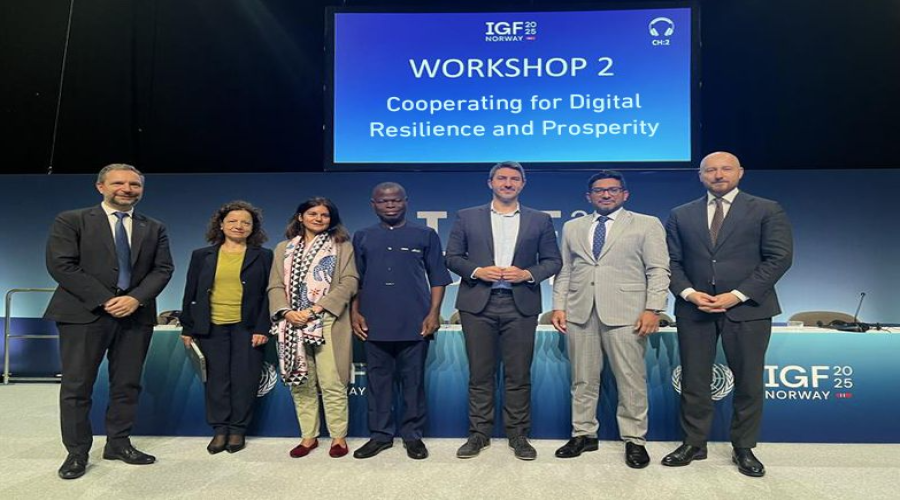
Digital Cooperation Organization (DCO) convened an Open Forum this week at the
20th Internet Governance Forum
(IGF), spotlighting the importance of inclusive, multilateral action
in driving resilience and prosperity in the global digital economy.
Bringing
together senior figures from the Agency for Digital Italy (AGID), the Economic Research Institute for ASEAN and East Asia (ERIA),
Fundação Getulio Vargas (FGV), Nortal, United Nations Conference on Trade and Development (UNCTAD),
and the World Intellectual Property
Organization (WIPO), as well as DCO Member States including the
Federal Republic of Nigeria and think tanks, the session titled “Cooperating
for Digital Resilience and Prosperity” highlighted the urgent need to align
transformative actions and avoid fragmentation across global digital initiatives.
Panelists agreed that in a world facing geopolitical polarization and economic
divides, digital cooperation is no longer optional but essential for promoting
inclusive growth and mitigating risk.
Speakers
underscored the importance of embedding the needs of the Global South and marginalized
communities into emerging digital goverenance frameworks, such as the Global
Digital Compact (GDC) and the WSIS+20 review process. They also stressed that
impact-driven cooperation must extend beyond the UN system, inviting more
robust engagement with regional entities, national governments, and grassroots
digital initiatives to ensure that knowledge, resources, and solutions are
shared effectively.
Hassan Nasser, Special Envoy for Multilateral Affairs at the
DCO, highlighted how the organization is helping members move from dialogue to
delivery. “Digital cooperation must go beyond declarations and become a
practical toolkit for development, inclusion, and innovation” he said. “It
is essential for all stakeholders to prioritize coordination to ensure that
collectively, we elevate our actions toward Global Digital Compact (GDC)
implementation and the Sustainable Development Goals (SDGs). Through our tools and frameworks, such as the data-based Digital
Economy Navigator, DCO is helping Member States translate
potential into policy, and policy into tangible progress for their people and
economies.”
Since
its founding in 2020, the DCO has grown to 16 member countries across Asia, Europe,
and Africa. Guided by its mission, they ensure that digital advances directly lead
to job creation, increased access to services, and greater equity for the 800
million people living in its Member States.
The
DCO’s engagement at IGF 2025 comes at a critical moment as global attention
builds ahead of WSIS+20, the
20-year review of the World Summit on the
Information Society, and the ongoing implementation of the Global
Digital Compact (GDC), a
United Nations-led framework for a shared, inclusive digital future. These
processes aim to establish guiding principles for digital governance. DCO’s
engagement at IGF 2025 served as a clear reminder that success will ultimately
depend on implementation at national and regional levels.
Participants
stressed the importance of aligning global initiatives with national
strategies, closing digital divides through innovative financing mechanisms,
and investing in data-driven policymaking to build more effective and equitable
digital economies. The discussion also highlighted the role of regional
integration in scaling innovation and digital trade, as well as the need for
greater coherence among international institutions to better serve the
priorities of developing countries.
By
convening this session at IGF 2025, the DCO reinforced its commitment to Member
State-led, yet globally coordinated multistakeholder digital development. Its
leadership in this space demonstrates that multilateralism can be both
inclusive and results-oriented, delivering tools, knowledge, and partnerships
that directly impact people’s lives.
As the
digital future becomes increasingly central to economic and social development,
the DCO’s role as a facilitator of meaningful, applied cooperation is more
important than ever. Through its active participation in global forums such as the
IGF and its ongoing support to Member States, the DCO continues to shape a
digital economy that is open, inclusive, and built to serve all.